Risk Management

Ten Commandments for a Successful Implementation of Digitalization Projects

Ten Commandments for a Successful Implementation of Digitalization Projects

Guidelines for Digital Transformation
Mikko Börkircher, Veit Hartmann, Tim Jeske
In many companies there is still a lack of clarity about the “right” way to implement digitalization projects. Therefore, the article describes guidelines for the successful implementation of digitalization projects. They are derived from the experience of various practical projects and include considerations of economic efficiency as well as resources and staff. Structured as “Ten Commandments for Digitalization Projects”, they are designed to support actors in the practical implementation of digitalization projects
Industrie 4.0 Management | Volume 36 | 2020 | Edition 6 | Pages 55-58
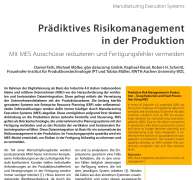
Predictive Risk Management in Production

Predictive Risk Management in Production

Scrap Reduction and Fault Prevention Using MES
Daniel Fath, Michael Möller ORCID Icon, Raphael Kiesel, Robert Schmitt ORCID Icon, Tobias Müller ORCID Icon
In terms of Industrie 4.0, especially SMEs are facing the challenge of integrating data both vertically and horizontally. To achieve this task, common solutions such as ERP are increasingly replaced by manufacturing executions systems (MES). Due to the direct connection in production, MES allow a production control and serve as bridge between planning and manufacturing level. Data integration is furthermore the basis for an automated risk management in production. The research project quadrika develops an MES module that predictively recognizes risks and thus prevents faults.
Industrie 4.0 Management | Volume 35 | 2019 | Edition 1 | Pages 53-56
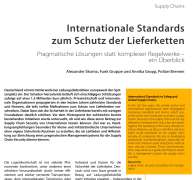
International Standards to Safeguard Global Supply Chains

International Standards to Safeguard Global Supply Chains

ein Überblick
Alexander Skorna, Annika Gropp
In the last few years, the private sector and international organizations have propagated numerous standards and norms, which prescribe some strict measures to protect supply chains. Security in the supply chain can be significantly increased with only a few principles. Against the backdrop of the many already existing initiatives, we discuss whether and how these could contribute to the supply chain security of companies. We aim at developing practitioner recommendations, especially for small and medium-sized enterprises without own security routines. These recommendations may serve as a guide and help to establish a management system for supply chain security.
Industrie 4.0 Management | Volume 33 | 2017 | Edition 2 | Pages 15-19
Recognize and Avoid Risks

Recognize and Avoid Risks

Potenziale von ganzheitlichen Produktionssystemen im Krankenhaus
Uwe Dombrowski, David Ebentreich
Risks threaten companies in all industries. Especially, if lives are threatened companies have to take measures for risk detection and prevention. The healthcare industry and especially hospitals have to identify risks as early as possible to take measures to protect patients. For this purpose the methods and tools from the lean production system can support hospital employees. Therefore, this paper analyses the support of lean production systems for improving patient safety in hospitals.
Industrie Management | Volume 30 | 2014 | Edition 5 | Pages 62-66
Deferred Payment as a Risk

Deferred Payment as a Risk

Robert Buchalik, Olaf Hiebert
Due to the German Insolvency Act and the jurisdiction of the Bundesgerichts-hof (German Supreme Court), revocatory actions of insolvency administrators against candid entrepreneurs seem to get out of hand. In case of an insolvency of a debitor, the creditor is often forced to depreciate all or part of his claims. In addition to that, insolvency administrators review long-time business relationships of the insolvent company and are able to reclaim payments that have been made to its business partners long before the petition for insolvency proceedings by means of revocatory action. Accordingly, insolvency administrators raise claims against two-thirds of all companies which are affected by the insolvency of a customer every year and, by that, might put the creditor himself on the line. According to a survey of the German Association of Credit Managers, the claims made are higher than Euro 100,000 in 40 percent of all cases. Business organizations [1] and politics [2] have already ...
Industrie Management | Volume 30 | 2014 | Edition 5 | Pages 53-56
Reducing the Purchase Price Volatility of Commodities

Reducing the Purchase Price Volatility of Commodities

Timo Six, Arnd Wiedemann
Commodity prices are one of the key cost drivers in industrial enterprises. Due to the volatility of market prices they hold a significant risk for potential losses. The purpose of this paper is to demonstrate how a purchase department can reduce the volatility of commodity prices by implementing an active risk management. It is shown how to carry out a systematic review and assessment of commodity price risks and how to smooth short-term price fluctuations by using effective instruments.
Industrie Management | Volume 30 | 2014 | Edition 5 | Pages 7-11
Risk Analysis and Risk Prognosis on Product Fleets in the Use Phase

Risk Analysis and Risk Prognosis on Product Fleets in the Use Phase

Die Methode „Risk Analysis and Prognosis of complex Products (RAPP)“ zur Berechnung von Produktflottenrisiken
Stefan Bracke, Sebastian Sochacki
The increasing complexity of product functionality and manufacturing process parameters often lead to complex failure modes during the product life cycle. Based on the detection of a damage case within the product using phase, a risk analysis and risk prognosis has to be carried out immediately. This paper outlines the essential procedure of the new developed method “Risk Analysis and Prognosis of complex Products (RAPP)”. Based on field data, the determination of damage probabilities, damage development and damage case prognosis for a comprehensive risk estimation regarding the product fleet within the usage phase is feasible.
Industrie Management | Volume 30 | 2014 | Edition 5 | Pages 27-31
Identification of Critical Supply Chain Processes

Identification of Critical Supply Chain Processes

Ein neuer Ansatz zur proaktiven Vermeidung kritischer Situationen in Versorgungsprozessen
Stefan Maurer, Gunther Reinhart, Severin Kreuels, Verena Rabenstein
External turbulences affecting producing industries are increasing because of rising natural and geopolitical changes. Due to this extended turbulences the vulnerability of today’s highly linked and complex supply chains of producing companies is rising. In terms of avoiding actual and future instabilities, critical processes need to be designed robust and flexible and to be monitored continuously. In order to initiate the necessary actions to guarantee the security of supply, critical processes have to be identified. For the evaluation of actual or future critical processes criticality gets introduced. So the influence of extended turbulences can be identified and possible instabilities can be detected and anticipated.
Industrie Management | Volume 30 | 2014 | Edition 5 | Pages 12-16
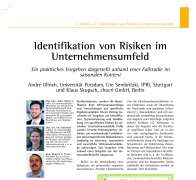
Risk Identification in Business Environments

Risk Identification in Business Environments

Ein praktisches Vorgehen dargestellt anhand einer Fallstudie im saisonalen Kontext
André Ullrich ORCID Icon, Ute Sembritzki, Klaus Skupsch
Risks in a company’s environment are a significant factor of uncertainty for long-term corporate success. In many cases, the main challenge is that decision makers are not aware of the influencing factors, their interdependencies and effects on outcomes. This article introduces an approach to efficiently identify risks within complex, e.g. seasonal, environments. This involves setting up cause-effect relationships to determine risks based on environmental factors, their interdependencies and effects. The approach is illustrated using the case of a company in the luxury food industry.
Industrie Management | Volume 30 | 2014 | Edition 5 | Pages 37-40
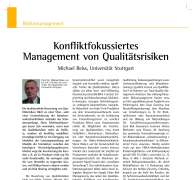
Conflict-Focused Management of Quality Risks

Conflict-Focused Management of Quality Risks

Michael Reiss
State-of-the-art risk assessments either overestimate or underestimate both probability and impact of quality risks. Misleading assessments can be avoided by modeling quality risks as conflicts instead of defects. Refocusing requires a transition from production approaches to interaction approaches covering several clusters of relevant actors in quality management. Customer involvement e.g. as a co-producer not only supports customer satisfaction and retention but also reduces producers’ costs since risk identification becomes more valid and risk sharing is enabled.
Industrie Management | Volume 30 | 2014 | Edition 5 | Pages 32-36
1 2 3 4