Logistics

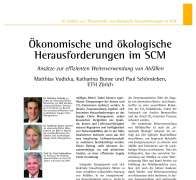
Economic and Ecologic Challenges in SCM

Economic and Ecologic Challenges in SCM

Approaches towards Efficient Recovery of Waste Materials
Matthias Vodicka, Katharina Bunse, Paul Schönsleben
Over the last decades, the cement industries achieved significant efficiency enhancements in their production processes. The so-called “co-processing”, the use of waste as a source of energy and raw material, was found to be both ecologically and economically beneficial. Cement plants can partially replace all fossil fuels by alternative ones and thus achieve significant reduction of cost and carbon footprint. Yet, in this context special challenges regarding supply chain management emerge. While respecting goals like quality, cost and delivery reliability, changing conditions need to be considered. Examples may be new regulations and the question of waste availability at nearby located industries as well as the desire to engage in long-term supply relationships. This article shows the relevant interrelations and presents approaches in order to contribute to a more efficient development of these supply chain relationships.
Industrie Management | Volume 27 | 2011 | Edition 6 | Pages 25-28
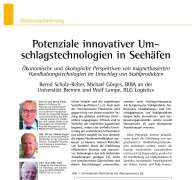
Potentials of Innovative Handling Technologies in Seaports

Potentials of Innovative Handling Technologies in Seaports

Ökonomische und ökologische Perspektiven von magnetbasierten Handhabungstechologien im Umschlag von Stahlprodukten
Bernd Scholz-Reiter ORCID Icon, Michael Görges, Wolf Lampe
The handling of general cargo in seaports is a time-consuming and resource-intensive activity. The implementation of novel handling technologies opens new potential to improve the handling process and its sustainability as well. This paper introduces a magnet system based approach for handling steel products in seaports and addresses its economical and ecological potentials. It presents a detailed event driven process chain model (EPC) of the handling process and an analysis of the corresponding potentials. Besides process related potentials like decreasing operative costs or increasing the process stability, this paper presents the capability of this new technology to reduce the ecological effects by saving dunnage.
Industrie Management | Volume 27 | 2011 | Edition 6 | Pages 38-42
Logistic Network of Offshore Wind Energy and Its Dynamic Effects

Logistic Network of Offshore Wind Energy and Its Dynamic Effects

Bewältigung dynamischer Einflüsse
Anne Schweizer, Thies Beinke, Bernd Scholz-Reiter ORCID Icon
The relevance of wind energy for the German energy supply increases steadily. This development is driven by the German withdrawal from nuclear energy as well as the ambitious climate policy goals. Furthermore, the fossil energy resources are limited. The logistic network which is needed to create an offshore-wind park is affected by dynamic disturbances like weather conditions as well as other influences. They have an impact on the material-pull which is initiated by the offshore construction site. Already scheduled processes cannot be proceeded which necessitates rescheduling of material flow process-plans. Sometimes material is also pushed back into the network.
Industrie Management | Volume 27 | 2011 | Edition 6 | Pages 13-16
Sustainable Cooperation in Logistics Networks

Sustainable Cooperation in Logistics Networks

Lösungsbausteine zur Bewertung des grünen Einsatzes von Logistikkonzepten
Volker Stich, Jan Helmig
The importance of sustainable planning and managing of networks by logistics concepts is rising. However, estimating these logistics concepts under sustainability aspects is a problem which many logistics managers have to face. The impact of logistics concepts to the target figures in a sustainable performance measurement system highly depends on the correlation between the variables. In this paper the correlation between the target figures within the functional areas of procurement, production, distribution and service are depicted. Based on these findings a cross-functional causal loop diagram is derived.
Industrie Management | Volume 27 | 2011 | Edition 6 | Pages 69-72
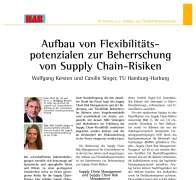
Implementing Flexibility to Manage Supply Chain Risks

Implementing Flexibility to Manage Supply Chain Risks

Wolfgang Kersten ORCID Icon, Carolin Singer
Nowadays, the economic determining factors are volatile and change dynamically leading to high uncertainty and risk for supply chain partners. Increased supply chain flexibility is not only considered as a success factor but is also essential for companies to remain competitive. The present article is based on selected results from expert interviews, a focus group as well as a survey analysing the status quo concerning supply chain risk management and the importance of flexibility. Afterwards, a process model is presented which consists of an approach to deduct strategies and measures in order to adjust supply chain flexibility in a structured way. The approach can be implemented for risk mitigation in practice.
Industrie Management | Volume 27 | 2011 | Edition 3 | Pages 61-64
The Application of Simulation Modules to Hedge Changeable Logistics Systems

The Application of Simulation Modules to Hedge Changeable Logistics Systems

Sigrid Wenzel ORCID Icon, Björn Bockel, Dennis Abel
Changeability is the capability of an organization to establish changes with a lasting effect. The possibility to correctly plan and create changeability of an organization already in the phase of plan-ning is an essential factor to be taken into account when considering changeable logistics systems. For this reason there is a need for conceptual change of established planning methods. In the context of discrete-event simulation, as an established planning method, the modular design of simulation models may be a first step to include changeability into model-based analysis. Against this background, This article discusses possibilities to build modular simulation models and shows how this modular design can be used in practice.
Industrie Management | Volume 27 | 2011 | Edition 3 | Pages 33-36
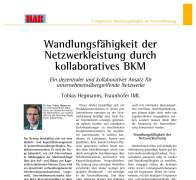
Adaptive Network Production by Collaborative Demand and Capacity Management

Adaptive Network Production by Collaborative Demand and Capacity Management

A Decentralized and Collaborative Approach for Inter-organizational Networks
Tobias Hegmanns
The article deals with the topic of demand and capacity management in inter-organizational production networks. It addresses the question how firms can coordinate build-up as well as reduction of the capacities of their production resources. For this purpose a decentralized negotiation-based coordination mechanism is presented. By this production networks are enabled to synchronize their capacities without the help of a central coordinator. The coordinating effect of the proposed decentralized planning approach was proven also in comparison to existing centralized network planning methods.
Industrie Management | Volume 27 | 2011 | Edition 3 | Pages 25-28
A New Approach for Handling Perturbations in Supply Chains

A New Approach for Handling Perturbations in Supply Chains

Bernd Scholz-Reiter ORCID Icon, Thomas Makuschewitz, Antonio G. Novaes, Enzo M. Frazzon
Dynamic production and logistics systems along supply chains have to operate smoothly with each other in order to satisfy customer demand in time. This task becomes even more challenging in the presence of perturbations affecting the systems. In order to address this challenge, information concerning capabilities and employment level should be appropriately exchanged between production and transportation systems. Nevertheless different stakeholders perform the planning and control of the individual systems, making locally bounded decisions. In this article we present a new approach for the alignment of production and transportation processes that enables an advanced handling of perturbations on the operational level. To this end we introduce a trigger that indicates when a re-planning of existing schedules becomes necessary. We also present a collaborative planning approach that allows for an advanced management of perturbations and a dynamic vehicle routing concept for the on time ...
Industrie Management | Volume 27 | 2011 | Edition 2 | Pages 19-22
An Approach for a Further Development of a Wearable Computing System

An Approach for a Further Development of a Wearable Computing System

Bernd Scholz-Reiter ORCID Icon, Dennis Lappe, Dirk Werthmann, Carmen Ruthenbeck
Wearable computing systems allow the support of workers in ongoing processes of automotive logistics. In a previous research project a wearable computing system, which is called easyTracing System, was developed. To this date, the easyTracing System is not technically mature because of the following reasons: First of all, the system was just tested in a laboratory. Hence, field tests are necessary, for example respective robustness. Besides, for supporting workers an efficient method for process controlling has to be developed. Both to make the technology of the easyTracing System workable and to develop an efficient method for process controlling are objects of research. This paper presents an approach for both development projects with the characteristic of a simultaneous processing.
Industrie Management | Volume 27 | 2011 | Edition 1 | Pages 17-20
Agile Supply Logistics

Agile Supply Logistics

Peter Faust, Stephan Sainer
After many improvements in production through the introduction of production systems, the focus is now shifting towards optimization of the supply side. Agility becomes to a success factor for supply logistics. New challenges arise from the increased demands of the “second lean wave”, from global supply structures and a turbulent environment. The design of the supply logistics begins at the “point of use”, at the workplace. A smoothed value stream takes place not only at the factory; it also requires a tacted supply at the supplier side: the utilization of tact principles at supplier transports is the logical extension of the production system in terms of a synchronous value stream. Prerequisite is logistics performance of the suppliers. An agile supply logistics optimizes proactively supply chain structures and processes.
Industrie Management | Volume 26 | 2010 | Edition 5 | Pages 31-35
1 11 12 13 19