Autor: Norbert Gronau

Applications and Systems for Knowledge Management a Market Survey

Applications and Systems for Knowledge Management a Market Survey

Norbert Gronau ORCID Icon, Stefan Dilz, André Kalisch
This market survey gives an overview on software for the support of knowledge management. The survey overlooks the span from specialized search engines to integrated knowledge management systems with a broad range of functions. The investigated software supports community-oriented approaches as well as information retrieval. Usage possibilities are as different as the heterogenous requirements of enterprises and organizations for knowledge management. Therefore a direct comparison between the investigated tools is not useful.
Industrie Management | Volume 21 | 2005 | Edition 1 | Pages 53-59
Market Survey of Consulting Firms Specialized in Factory Planning

Market Survey of Consulting Firms Specialized in Factory Planning

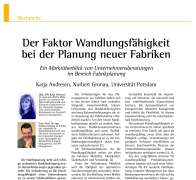
Katja Andresen, Norbert Gronau ORCID Icon
The article highlights the current challenges factory planning is facing in the realm of changeability and the creation of flexible structures, which adapt to changing market environments. IM has conducted a survey among factory planning companies and provides the results as well as annotating remarks in this report.
Industrie Management | Volume 20 | 2004 | Edition 4 | Pages 61-69
Development and Application of Adaptive Enterprise Resource Planning Systems

Development and Application of Adaptive Enterprise Resource Planning Systems

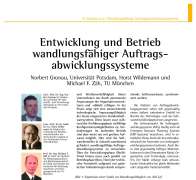
Norbert Gronau ORCID Icon, Horst Wildemann, Michael F. Zäh
Medium-sized industrial enterprises apply resource planning systems for their business processes. Changing markets require permanent adaptation of these enterprises’ organisational structures and processes to ensure their efficiency and their competitiveness. However, currently applied standard software systems have proven to be insufficiently adaptable. They allow multiple configuration options during implementation and setup, but it is hardly possible to perform configuration changes during the application phase. Therefore software developers will have to focus on adaptable enterprise resource planning systems in future. Beyond the development phase (build time) technological progress caused by changing requirements also has to be synchronised simultaneously by current software releases during the application phase (run time).
Industrie Management | Volume 20 | 2004 | Edition 2 | Pages 25-30
K_MOBILE—Enabling Mobile Access to Information and Knowledge

K_MOBILE—Enabling Mobile Access to Information and Knowledge

An approach for extending enterprise information infrastructures
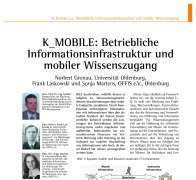
Norbert Gronau ORCID Icon, Frank Laskowski, Sonja Martens
Software supporting knowledge management and knowledge intensive business processes is mainly planned and deployed for stationary use. The average time needed to process information can effectively be reduced by adding a mobile channel to existing knowledge management software, e.g. when negotiating with business partners or maintaining individual technical installations. In this paper the authors describe K_MOBILE, a concept enabling access to knowledge management services through the mobile channel in a situation aware manner. Access to information systems can be truly adopted to mobile use, with help of a user specific context built by combining available information with respect to time and location. This is a benefit especially when carrying out intensive tasks in sale, consulting, technical services, because it is difficult to estimate the actual need for information and hence the costs of access to this information is potentially very high.
Industrie Management | Volume 19 | 2003 | Edition 6 | Pages 21-24
Knowledge Modeler Description Language (KMDL)

Knowledge Modeler Description Language (KMDL)

Modeling knowledge-intensive business processes
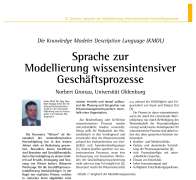
Norbert Gronau ORCID Icon
Knowledge as a resource for business value creation became an increased importance during the last years. Industries are mainly influenced, which value creation is basing for the most part on the acquisition, generation and usage of knowledge. Known tools for business process modelling only consider explicit knowledge which is represented in a formal manner. There is no focus on person-related knowledge that is not mainly used for information processing. KMDL allows the modelling and analysis of knowledge intensive business processes like software engineering, mechanical design or technical sales and basing on this the planning of knowledge management systems and their integration into a firm.
Industrie Management | Volume 19 | 2003 | Edition 3 | Pages 9-13
1 5 6