Autor: Michael Freitag

Geometry Oriented Process Chain Design for Micro Manufacturing

Geometry Oriented Process Chain Design for Micro Manufacturing

Daniel Rippel, Michael Lütjen ORCID Icon, Michael Freitag ORCID Icon
Exact planning and configuration of process chains contributes significantly to manufacturing excellence in micro manufacturing. In this type of manufacturing, production must adhere to very low tolerances. Furthermore, a multitude of manufacturing processes is available in micro manufacturing whereas some processes are better suited than others for given tasks. The methodology “Micro Process Planning and Analysis” (µ-ProPlAn), which is described in this article, provides suitable means for planning and configuration of such process chains with the necessary level of detail. To reduce the manual workload in comparing alternative process chains, this article proposes an extension, which enables an automatic selection of alternative processes based on a geometry oriented annotation of the µ-ProPlAn process models.
Industrie 4.0 Management | Volume 32 | 2016 | Edition 2 | Pages 50-53
Climbing Robot for Attaching RFID Transponders

Climbing Robot for Attaching RFID Transponders

Development of the Pallet-Tagging-Robot PaTRo
Dirk Werthmann, Tim Schmohl, Kolja Schmidt, Michael Freitag ORCID Icon
Based on the specification of the European Pallet Association (EPAL) and GS1 the Pallet-Tagging-Robot (PaTRo) was developed. Special about the patented robot is that it can climb pallet stacks without additional equipment and can attach two RFID transponders to each pallet. During the whole process for tagging each pallet of the stack PaTRo is just supported by the stack. That is why PaTRo is very flexible and mobile for being moved to the location where the tagging should take place. For realizing the described features the construction of the robot is based on lightweight design.
Industrie 4.0 Management | Volume 32 | 2016 | Edition 2 | Pages 19-24
Robotics as Key Component for Logistics 4.0

Robotics as Key Component for Logistics 4.0

Flexible Robotersysteme für dynamische Logistikprozesse
Hendrik Thamer, Florian Loibl, Claudio Uriarte, Michael Freitag ORCID Icon
In contrast to the use of robots in standardized production processes, robots must be flexible and adaptable within dynamic logistics processes in order to cope with variable environmental conditions and non-standardized goods. Due to the recent advances in the field of artificial intelligence and networking through industry 4.0, robots will perform complex tasks in logistics in a reliable way in future. A crucial component of a robot system represents the interpretation of the work environment with the help of multi-modal sensor systems, especially image processing systems. This paper describes applications for robotic systems in logistics as well as a concrete example of focusing on the interpretation of multi-modal sensor data for the automation of a logistics task.
Industrie 4.0 Management | Volume 32 | 2016 | Edition 2 | Pages 15-18
Autonomous Discharge of Coffee Sacks from Overseas Containers

Autonomous Discharge of Coffee Sacks from Overseas Containers

A method involving an innovative gripper technology
Rafael Mortensen Ernits, Stefan Kunaschk, Moritz Rohde, Michael Freitag ORCID Icon
In many fields of production for processing tasks with high frequency and repeatability, robots are commonly used. However, the use of industrial and service robots also increases in the logistics sector. Container handling, particularly the unloading of for example coffee sacks, has enormous potential for automation with robotics. The heavy weight together with the deformability of these sacks and unpredictable stack situations inside a container have the highest mechanical and cognitive demands on the gripper technology and the corresponding gripping strategy. This paper describes the development and implementation of such a gripping process.
Industrie Management | Volume 31 | 2015 | Edition 6 | Pages 51-55
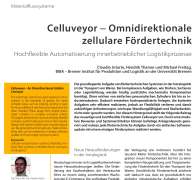
Celluveyor – An Omnidirectional Cellular Conveyor

Celluveyor - An Omnidirectional Cellular Conveyor

Hochflexible Automatisierung innerbetrieblicher Logistikprozesse
Claudio Uriarte, Hendrik Thamer, Michael Freitag ORCID Icon
The most basic task of conveyor systems in intra-logistics is the transport of goods. For more complex tasks, such as rotating, sorting or layer forming, additional mechanical components are often needed. These range from simple pneumatic cylinders to complex industrial robots. This paper presents the novel and highly flexible conveyor system Celluveyor. Due to the modular design and system architecture, any plant layout can be generated and virtually any material handling task can be realized by a simple software update with one single conveyor system.
Industrie Management | Volume 31 | 2015 | Edition 6 | Pages 20-23
Potentials of Data Science in Production and Logistics

Potentials of Data Science in Production and Logistics

Part 2—Procedure for data analysis and application examples
Michael Freitag ORCID Icon, Mirko Kück, Abderrahim Ait Alla ORCID Icon, Michael Lütjen ORCID Icon
The importance of data science for production and logistics continues to grow because more data are available due to Industry 4.0-Applications used for process and system optimization. In addition, the improved methods and tools for data analysis enable an easier processing of application-specific issues. This article is the second part relating to data science in production and logistics. While the first article dealt with the definition of terms and the potential of data analysis, the article at hand is dedicated to the application of data science in production and logistics by means of various application examples.
Industrie Management | Volume 31 | 2015 | Edition 6 | Pages 39-46
Potentials of Data Science in Production and Logistics Part 1

Potentials of Data Science in Production and Logistics Part 1

An Introduction into Current Approaches of Data Science
Michael Freitag ORCID Icon, Mirko Kück, Abderrahim Ait Alla ORCID Icon, Michael Lütjen ORCID Icon
The implementation of industry 4.0 concepts requires a new understanding of data processing and analysis. Data Science integrates approaches of mathematical modelling and performant implementation to analyse data of specific application areas. Within this first article, the basics of Data Science are presented and perspectives for a data-driven production and logistics are discussed. Within a second article in a following edition, the process steps for structured data analysis will be explained and illustrated by means of application examples.
Industrie Management | Volume 31 | 2015 | Edition 5 | Pages 22-26
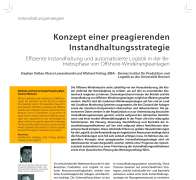
Methods and Tools to Enable Preacting Maintenance Measures

Methods and Tools to Enable Preacting Maintenance Measures

Effiziente Instandhaltung und automatisierte Logistik in der Betriebsphase von Offshore-Windenergieanlagen
Stephan Oelker, Marco Lewandowski, Michael Freitag ORCID Icon
Efficient operation and maintenance (O&M) processes are important success factors to reduce the operating costs in the operation phase of industrial assets. Therefore, companies use different maintenance strategies that are well known from literature. Due to uncertainties in occurrence of faults and the duration of process fulfilment, strategies even supported by new technologies do often not fit to the specific real-world challenges. The focus of this paper is to discuss a new concept where operation data analysis is used to support decisions for logistics maintenance processes.
Industrie Management | Volume 31 | 2015 | Edition 5 | Pages 40-44
Perspectives of Shared Resources in Production

Perspectives of Shared Resources in Production

Eine Analogie zwischen Web 2.0 und Industrie 4.0 als Basis für gemeinsam genutzte Ressourcen
Michael Freitag ORCID Icon, Dennis Lappe
Companies have to cope with an individualization of products. Consequently, they are confronted with an increasing cost pressure and thus, they require optimal manufacturing processes. A possible approach is to share manufacturing resources with other companies to maximize the utilization of these resources. This paper describes possible perspectives of resource sharing for companies by using an analogy between the Web 2.0-based Share Economy and resource sharing of tomorrow’s production based on Industry 4.0.
Industrie Management | Volume 31 | 2015 | Edition 4 | Pages 39-42
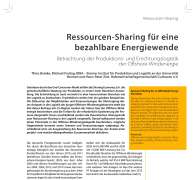
Resource Sharing for an Affordable Energy Transition

Resource Sharing for an Affordable Energy Transition

Betrachtung der Produktions- und Errichtungslogistik der Offshore-Windenergie
Thies Beinke, Michael Freitag ORCID Icon, Hans-Peter Zint
Having derived from the end consumer market, the idea of a sharing economy is currently increasing important in more and more economic branches. Even conservative industries such as logistics are now beginning to see the potential of resource sharing. This paper discusses the scope and conditions of transferring this approach to the field of offshore wind energy logistics. It will be shown that standardizing objects and processes as well as making supply and demand transparent are considered the basis for transferring resource sharing into offshore wind energy logistics.
Industrie Management | Volume 31 | 2015 | Edition 4 | Pages 7-11
1 4 5 6