Autor: Günther Schuh

To Decide Correctly, Designing Learning Effects

To Decide Correctly, Designing Learning Effects

Günther Schuh ORCID Icon, Sebastian Gottschalk, Bastian Franzkoch, Axel Hoeschen
Due to shortening product life cycles, complex supplier networks and an increasing number of parties involved, the decision making process has become both more critical and more difficult. The complexity and dynamics of the ramp-up phase make it necessary to not try to concentrate the decisions in on hand, but rather distribute decisions among decentralized yet competent decision makers on-site. It is, however, necessary to provide the decentralized decision makers with the basis and the capability of decision making, and a joint target system to ensure optimal outcome. The paper presents a heuristic approach to design and operate production ramp-up appropriate to stable and efficient ramp-up processes.
Industrie Management | Volume 23 | 2007 | Edition 3 | Pages 71-74
Global Footprint Design

Global Footprint Design

Heuristics for the design of the multi-national cooperation
Günther Schuh ORCID Icon, Sebastian Gottschalk, Jan Harre, Axel Hoeschen
With new markets and decreasing transfer barriers producing companies are facing new possibilities for the optimization of their value chain regarding factor and sourcing cost as well as business opportunities in new markets. Global Footprint Design is therefore a highly relevant business issue which needs to address global cost advantages on one hand and exploitation of markets on the other. The paper presents a heuristics for footprint design which is oriented towards these opportunities.
Industrie Management | Volume 23 | 2007 | Edition 1 | Pages 43-46
Sustainable Maintenance – Potential and Fields of Action

Sustainable Maintenance - Potential and Fields of Action

Results of a study conducted in German Enterprises
Günther Schuh ORCID Icon, Nils Wemhöner, Bastian Franzkoch, Achim Kampker
The importance of maintenance in the producing industry keeps increasing. Maintenance costs in the old EU countries have doubled every decade; according to estimations, they amount to about 9,000 billion Euros per year. Long considered a sleeping beauty, many companies have recognized the importance of a holistic management of availability. However, the potentials and field of action in sustainable maintenance are widely unknown. The VDMA, the Fraunhofer Institute for Material Flow and Logistics (Dortmund) and the Laboratory for Machine Tools and Production Engineering (WZL) of the RWTH Aachen University of Technology have conducted a study to investigate the status and the potentials of maintenance in German companies. The study has been supported by the German Ministry of Education and Research (BMBF). Problems and solutions as well as their implementation potential have been analyzed in the field of technology, strategy, organization, and business models. The study confirms that ...
Industrie Management | Volume 22 | 2006 | Edition 4 | Pages 20-24
Complexity-Based Design of Collaborations

Complexity-Based Design of Collaborations

A Chance to Save Germany’s Industrial Locations
Günther Schuh ORCID Icon, Alexander Schauer, Sebastian Döring
The intensive international competition exerts strong cost pressure on Germany’s producing companies. Hence, managers more and more decide to relocate industrial locations to foreign countries in order to reduce their costs. However, not all possibilities to strengthen and to sustainably save Germany’s industrial locations have been tapped, yet. One step towards this that is supposed by companies to keep a high potential, is to collaborate. A new approach for the design of collaborations focussing complexity drivers shall raise the probability of success of collaborative goods and services.
Industrie Management | Volume 22 | 2006 | Edition 3 | Pages 72-74
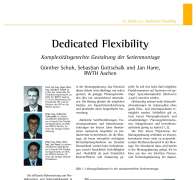
Dedicated Flexibility – Design to Complexity of Series Assembly

Dedicated Flexibility - Design to Complexity of Series Assembly

Komplexitätsgerechte Gestaltung der Serienmontage
Günther Schuh ORCID Icon, Sebastian Gottschalk, Jan Harre
Mastering high product variance and life cycle dynamics of demand can be an important competitive advantage in assembly. The main lever to this is a smart structuring of capacities and their assignment to assembly resources, such as lines, stations etc. The true benefit of this lever is hardly exploited due to poor support by established design methodologies. The article presents possible approaches to structure capacities in assembly and shows their exemplary use in practice.
Industrie Management | Volume 22 | 2006 | Edition 2 | Pages 21-25
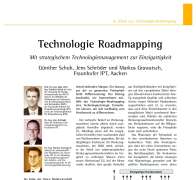
Technology Roadmapping

Technology Roadmapping

Building up uniqueness with strategic technology management
Günther Schuh ORCID Icon, Jens Schröder, Markus Grawatsch
As a result of the free market economy in the global environment, in almost any branch more products are offered than needed. Due to this overcapacity, companies enter a price war with corresponding declining profit margins. By differentiation, a company can escape this so-called price spiral. This article argues that companies can formulate their technological strategy with the help of technology roadmapping by differentiating themselves from their competitors.
Industrie Management | Volume 22 | 2006 | Edition 1 | Pages 23-26
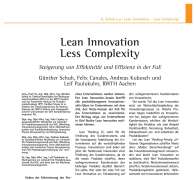
Lean Innovation – Less Complexity

Lean Innovation - Less Complexity

Increase of effectiveness and efficiency in R&D
Günther Schuh ORCID Icon, Felix Canales, Andreas Kubosch, Leif Paulukuhn
Currently next to the minimization of the production costs the R&D-costs are coming to the fore. This is not just because the share of the R&D-costs in the product costs increases constantly, but also because in a lot of cases the R&D-resources run short and thus become the bottleneck of innovation. The lean innovation approach is concerning all the company’s product-related innovation activities targeting at the maximization of the net benefit of R&D. This article demonstrates the 5-step-realization of lean innovation in companies.
Industrie Management | Volume 21 | 2005 | Edition 3 | Pages 21-24
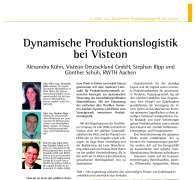
Dynamic In-House Logistics at Visteon

Dynamic In-House Logistics at Visteon

Alexandra Kühn, Stephan Ripp, Günther Schuh ORCID Icon
Visteon is one of the largest automotive suppliers world-wide and is focused on innovation and permanent improvement. For Visteon that means the consistent implementation of Lean Manufacturing concepts. Thereby lean in-house logistics represent a core aspect. For that reason the Visteon plant at Düren is developing innovative concepts for the dynamic controlling of the overall material flow together with the chair of production systematics of the university of Aachen. With the implementation of the simple yet flexible variant Kanban system Visteon plant Düren is obtaining a leading position with regard to innovative in-house logistics.
Industrie Management | Volume 20 | 2004 | Edition 3 | Pages 21-24
Intensive Resource Utilization for Sustainability

Intensive Resource Utilization for Sustainability

Günther Schuh ORCID Icon, Lutz Frick, Martin Schönung
The recent developments have changed the markets of producing indus-tries. To be successful, producing enterprises especially manufacturers of machinery and equipment have to exploit new potentials. Especially in production increased resource utilization offers the possibility to benefit from hidden chances to realize competitive advantage. Dominant for this purpose are Technology-Leverage-Effects with economic and ecological implications. Production will be successful sustain-able if adequate concepts of usage enable an optimized utilization rate.
Industrie Management | Volume 19 | 2003 | Edition 4 | Pages 28-31
1 2