

-
×
 Challenges for Midsized Subcontractors in the Aviation Industry
1 × 29,00 €
Challenges for Midsized Subcontractors in the Aviation Industry
1 × 29,00 € -
×
 Identification of Cooperation Potentials in Existing Inter-Company Networks
1 × 29,00 €
Identification of Cooperation Potentials in Existing Inter-Company Networks
1 × 29,00 € -
×
 Digital Factory Supports Planning of Final Assembly
1 × 29,00 €
Digital Factory Supports Planning of Final Assembly
1 × 29,00 € -
×
 Realistic Process Controlling in Production Networks
1 × 29,00 €
Realistic Process Controlling in Production Networks
1 × 29,00 €

Quantification of the Counterparty Risk in the Crisis |
Risks from the insolvency of suppliers and customers
| Journal | Industrie 4.0 Management |
| Issue | Volume 37, 2021, Edition 1, Pages 32-36 |
| Open Access | https://doi.org/10.30844/I40M_21-1_S32-36 |
| Bibliography | Share | Cite | Download |
Abstract
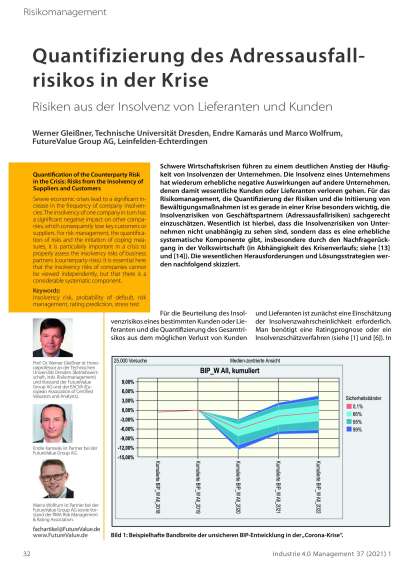
Severe economic crises lead to a significant increase in the frequency of company insolvencies. The insolvency of one company in turn has a significant negative impact on other companies, which consequently lose key customers or suppliers. For risk management, the quantification of risks and the initiation of coping measures, it is particularly important in a crisis to properly assess the insolvency risks of business partners (counterparty risks). It is essential here that the insolvency risks of companies cannot be viewed independently, but that there is a considerable systematic component.
Bibliography
[1] Bemmann, M.: Entwicklung und Validierung eines stochastischen Simulationsmodells für die Prognose von Unternehmensinsolvenzen, Dissertation, Technische Universität Dresden 2007.[2] Gleißner, W.; Bemmann, M.: Die Rating-Qualität verbessern. In: die bank 9 (2008), S. 51-55.
[3] Gleißner, W.; Romeike, F.: Kreditrisikomanagement im Kontext einer wert- und risikoorientierten Unternehmensführung. In: Risiko Manager Sonderheft Credit Management, Special II (2008), S. 4-12.
[4] Gleißner, W.; Grundmann, T.: Risiko-Benchmark-Werte für das Risikocontrolling deutscher Unternehmen. In: ZfCM Zeitschrift für Controlling & Management, 5/2008, S. 314-319
[5] Hock, T.; Gleißner, W.; Kamarás, E.: Wertorientiertes Credit Management: Zusammenfassung von Rating, Marge und Umsatzentwicklung.In: Bundesverband Credit Management e.V. (BvCM) (Hrsg): Das Credit Management als Erfolgsfaktor in der Unternehmenspraxis (Tagungsband zum Bundeskongress BvCM 2012).
[6] Gleißner, W.; Wingenroth, T.: Rating und Kreditrisiko (1). In: Kredit & Rating Praxis 5 (2015a), S. 14-18.
[7] Gleißner, W.; Wingenroth, T.: Rating und Kreditrisiko (2). In: Kredit & Rating Praxis 6 (2015b), S. 19-22.
[8] Gleißner, W.; Füser, K.: Praxishandbuch Rating und Finanzierung unter Basel III, 3. Auflage, Verlag Franz Vahlen, München 2014.
[9] Gleißner, W.: Grundlagen des Risikomanagements, 3. Auflage, Verlag Franz Vahlen, München 2017.
[10] Gerdes, K.: Rating mittelständischer Unternehmen – Charakteristika mittelständischer Unternehmen und Besonderheiten bei der Bewertung des Kreditrisikos. In: Controller Magazin 6 (2018), S. 57-61.
[11] Gleißner, W.: Risikomanagement 20 Jahre nach KonTraG: Auf dem Weg zum entscheidungsorientierten Risikomanagement. In: Der Betrieb 46 (2018), S. 2769-2774.
[12] Gleißner, W.; Wolfrum, M.: Risikoaggregation und Monte-Carlo-Simulation – Schlüsseltechnologie für Risikomanagement und Controlling, springer essentials, Springer Fachmedien Verlag, Wiesbaden 2019.
[13] Gleißner, W.: Die Corona-Krise: Fakten, Prognosen und Risiken. In: Corporate Finance 5-6 (2020), S. 121-130.
[14] Gleißner, W.; Kamarás, E.: Volkswirtschaftliche Risiken und deren betriebswirtschaftliche Konsequenzen (1). In: Der Betrieb 33 (2020), S. 1689-1695.
[15] Gleißner, W.; Kamarás, E.: Volkswirtschaftliche Risiken und deren betriebswirtschaftliche Konsequenzen (2). In: Der Betrieb 34 (2020), S. 1745-1753.
Your downloads
Solutions: Risk Management
