Simulation

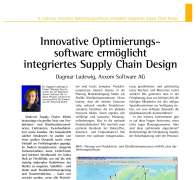
Optimization Software Enables Integrated Supply Chain Design

Optimization Software Enables Integrated Supply Chain Design

Dagmar Ludewig
Modern supply chains today consist of a wide network of production and distribution sites, suppliers, vendors and customers. Moreover, the complexity of such sytems is affected by great dynamics and a multitude of degrees of freedom. The rising number of variants, short delivery periods and the severe competition for instance call for a high degree of flexibility to adapt to the permanently changing market needs. Stability - and with it an increase of productivity and cost reduction - can only be achieved when all activities within the supply chain are based on a holistic and end-to-end planning scenario. In the ideal case it should map each link of the supply chain.
Industrie Management | Volume 22 | 2006 | Edition 3 | Pages 78-81
Real Time Factory Cockpit for Medium-Sized Businesses

Real Time Factory Cockpit for Medium-Sized Businesses

Ralf Kapp, Jan le Blond, Stephan Schreiber, Matthias Pfeffer, Engelbert Westkämper
This technical contribution presents a digital planning environment for an integrated facility layout and logistics planning. The aim is a noticeable reduction of time and effort for middle- and long-term facility planning and production planning. Therefore current data from the shop floor and order management are provided in an object-oriented consistent digital structure. This data is used to forecast the need for action and to deduct alternative solutions. Planning becomes more effective, long-term planning tasks become day-to-day activities so that the flexibility of the enterprise increases.
Industrie Management | Volume 22 | 2006 | Edition 2 | Pages 49-52
Germany as Industrial Location – Even in Germany Money Can Be Earned!

Germany as Industrial Location - Even in Germany Money Can Be Earned!

Auch in Deutschland lässt sich Geld verdienen!
Horst Wildemann
Although the relocation trend has slightly decreased during the last five years, nowadays more companies plan to shift abroad in the near future. In particular small- and medium-sized companies plan the relocation of parts of their value chain. The disadvantage of the German location can only be compensated by a combination of cost optimization and an increase of productivity. A systematic procedure and the application of sophisticated evaluation tools support the company in its process of decision making. Considering the type of business, guidelines for competitive value chain management can be developed.
Industrie Management | Volume 22 | 2006 | Edition 1 | Pages 15-18
Dynamic After Sales Control A Life Cycle Based Approach

Dynamic After Sales Control A Life Cycle Based Approach

Ein lebenszyklusbasierter Modellansatz
Jörn Ewaldt, Raul Sfat
Technology driven industries are facing new challenges to manage the spare part business of high-quality products due to decreasing innovation cycles and increasing product complexity. An influencing factor for the total profitability is the after-sales strategy for spare parts after the end-of-production decision of a product. On the one hand the guaranteed service level can be achieved by excess stocks and expensive scrapping actions. On the other hand if out of stock situations may occur, penalties and an eventual image loss have to be taken into account. Both strategies can be combined to reduce costs significantly by using a dynamic life cycle simulation approach.
Industrie Management | Volume 21 | 2005 | Edition 5 | Pages 79-82
Autonomous Control in Transport Logistics: Modelling Communication

Autonomous Control in Transport Logistics: Modelling Communication

Modellierung der mobilen Kommunikation
Markus Becker, Andreas Timm-Giel
High dynamics and structural complexity in current and future logistic systems are complicating central planning and control. For enabling a more decentralised and autonomous control, communication between the elements of the logistical network are necessary for the provisioning of the information needed. This article details the modelling of the communication between the components. This modelling contains source and sink of the information as well as the amount of data, frequency of transmission, quality of service and the moment of transmission for a reasonable usage of the information. The technical feasibility with current and upcoming communication systems is evaluated under consideration of the model.
Industrie Management | Volume 21 | 2005 | Edition 5 | Pages 71-74
Instabilities in Dynamic Production and Logistic Networks

Instabilities in Dynamic Production and Logistic Networks

Simulation-based analysis
Bernd Scholz-Reiter ORCID Icon, Uwe Hinrichs, Salima Delhoum
Production and logistics networks are characterized by an increasing dynamic and structural complexity, which makes an efficient planning more difficult. Observed non-linear dynamic effects, which in case of similar causes can lead to different results, contribute additionally to this problem. As a consequence strong inventory fluctuations can appear among others, which represent a strong economically load for network participants. The simulation-supported analysis of these connections is the main focus of this article. Moreover as a result of the analysis ways and means are pointed out, which will help to react more adequately to the given problems.
Industrie Management | Volume 21 | 2005 | Edition 5 | Pages 25-28
Autonomous Cooperating Logistic Processes for Automobile Terminals

Autonomous Cooperating Logistic Processes for Automobile Terminals

Felix Böse, Jakub Piotrowski, Katja Windt
Logistic systems of automobile terminals are characterised these days by central planning and control processes, which do not allow fast and flexible adaptation of order processing to changing environmental influences caused by the dynamic and complexity in logistics. Process flows of cars on an automobile terminal such as delivery, storage and technical treatment are supported by a conventional, centralised logistic system. By establishing autonomous cooperating logistics processes, the automobiles will be enabled to act independently according to their own objectives and navigate through the logistics network themselves. This paper introduces first approaches of autonomous cooperation in the context of logistics and investigates potential applications in automobile logistics on the example of E. H. Harms Auto-Terminal-Hamburg GmbH & Co. KG.
Industrie Management | Volume 21 | 2005 | Edition 4 | Pages 37-40
Systematic Process Design

Systematic Process Design

Development state and applications of the integrated production process model (IPPM)
Jan C. Aurich, Christian Wagenknecht, Christian Fuchs
The design of cross-enterprise production processes can be significantly supported by the systematic usage of process modeling methodologies. The following paper shows current and future research work concerning the Integrated Production Process Model (IPPM). Major improvements are related to the integration both of physical and non-physical products and the closed description of cross enterprise production processes. An integrated modeling methodology based on a predefined process module library supports the design process.
Industrie Management | Volume 21 | 2005 | Edition 4 | Pages 23-27
Reducing Energy Peaks by Factory Simulation

Reducing Energy Peaks by Factory Simulation

Jens Hesselbach, Mark Junge
Industry sectors with high energy consumption like the plastics processing industry already have high energy costs. In the short and medium term a further rise in energy prices can be expected. Not only the consumed energy quantity affects the costs but also the energy peaks. By the use of factory simulation the energy peaks of a model are simulated. An optimisation of the logistic control to reduce energy peaks is realised and the effects are described.
Industrie Management | Volume 21 | 2005 | Edition 2 | Pages 35-37
Value-Added Processes in Textile Enterprise Networks

Value-Added Processes in Textile Enterprise Networks

An approach using knowledge-oriented modeling
Thomas Fischer, Sven-Volker Rehm
In the scope of European Community research projects at ITV Denkendorf new approaches for the management of Dynamically Networked Enterprises have been examined. New conceptions for coordination and planning integration within value added communities in enterprise networks have been developed. They have been implemented on e-business platforms with the help of newly developed knowledge-oriented methodologies for network analysis and design. The article describes the conceptional approaches and highlights the role of knowledge classes for design and management of value added partnerships. Finally, an outlook towards the future design of knowledge repositories for networks is given.
Industrie Management | Volume 21 | 2005 | Edition 1 | Pages 29-32
1 9 10 11