Sensors

Technology-driven changes in maintenance of centrifugal pumps

Technology-driven changes in maintenance of centrifugal pumps

Britta Kohlmann, Gerhard Bandow
Today, the maintenance of pump systems is based mainly on either a breakdown strategy or a time-based maintenance strategy. There are several disadvantages of these strategies: the required availability often is not reached, unscheduled downtimes occur and costs increase because of necessary redundant resources. In future, the requirements of a plant for efficient and cost-effective operation can only be reached through predictive maintenance. In this context, the combined use of technologies like RFID (Radio Frequency Identification) and condition monitoring techniques is a possible solution to increase the efficiency of operation and maintenance. This is accompanied by significant technology-driven organizational changes in maintenance as simplification of work procedures, additional personnel qualification requirements and decentralization of maintenance activities, i.e. on-site maintenance of pumps. Thus, the efficiency and effectiveness potentials of maintenance will be realized ...
Industrie Management | Volume 25 | 2009 | Edition 2 | Pages 59-62
Cognitive Authentication Technology for Anti-Counterfeiting

Cognitive Authentication Technology for Anti-Counterfeiting

Willibald A. Günthner, Janina Durchholz, Sebastian Meißner, Dominik Stockenberger
On the technical level there are different possibilities to fight counterfeiting and to prohibit the use of counterfeited parts in machinery and equipment. The aim should be to enable the machinery control to recognize the exchange of wearing or the assembly of additional parts automatically and to check its originality independently. RFID offers not only the conditions to realise the suggested functions but also to implement additional benefits for manufacturer and customer.
Industrie Management | Volume 24 | 2008 | Edition 6 | Pages 23-27
Protection Concept against Product Piracy for Pharmaceutical Industries

Protection Concept against Product Piracy for Pharmaceutical Industries

Max Reinecke, Henner Gärtner, Ludger Overmeyer
Globally increasing imitation of products increases pressure on introducing protective concepts. Analyzing constraints such as the product and the distribution process and examining protective measures are the conditions for protecting effectively. A balance between technically achievable solutions and economically justifiable efforts is to be found. Therefore, a research project of the Institute of Integrated Production Hannover focuses on RFID based authenticity certificates in folded boxes for pharmaceutical products.
Industrie Management | Volume 24 | 2008 | Edition 6 | Pages 35-38
Material Flow Simulation and Cost Efficiency

Material Flow Simulation and Cost Efficiency

Daniel Neuhäuser, Klaus-Peter Rahn, Karl-Heinz Wehking
The following article describes an integrated method to calculate the investment and (cost-) effectiveness of a process optimisation using innovative techniques like RFID. It is based on the research project IdentProLog. Starting with analysing and optimizing processes it‘s possible to evaluate them with a method like activity-based-costing. The detailed information about process-times for each resource will be taken from a material flow simulation. Using this way its possible to create and format data with a high confidential level. Furthermore, it is possible to consider dependencies between technical resources, even in your investment analysis.
Industrie Management | Volume 24 | 2008 | Edition 4 | Pages 17-20
Real-Time Location in the Automotive Industry

Real-Time Location in the Automotive Industry

Practical application with passive RFID tags at Ford
Fatih Koyuncu, Manfred Grauer
During the launch phase thousands of vehicles are produced in order to supply the dealer at the announced commercial launch. At the early production stage quite a number of repair and retrofit jobs are done. It is not possible to park the repaired or retrofitted cars in an orderly manner. The cars are brought to other regions of the plant site, thus the result is a chaotic parking and the cars cannot be found back in time. The produced cars have to stay at the plant site until the approval from business is given. After the approval the cars have to be delivered to the dealer. Due to the chaotic parking systems the searching for specific vehicles causes a lot of extra workload internally. In order to save costs and time OEMs implement Real-time Location Systems (RTLS) based on RFID to guarantee an accurate location follow-up of parking cars. This paper describes the deployment of passive RTLS on the Ford plant site. Hereby the focus will be on the inter-corporate use with suppliers in ...
Industrie Management | Volume 24 | 2008 | Edition 3 | Pages 24-26
PLM for Individual Real Products

PLM for Individual Real Products

Produktindividuelles Informationsmanagement auf Basis einer Produkt-Traceabitlity-Lösung
Michael Abramovici, Fahmi Bellalouna, Matthias Flohr
Existing PLM solutions provide mature methods and functionalities for the management of processes and data of virtual products in the early product lifecycle phases. Appropriate solutions for managing information of individual real physical products within the production, use and end-of-life phases are not available. In this article an approach for a product-individual information management is presented, which is based on a product traceability solution.
Industrie Management | Volume 24 | 2008 | Edition 3 | Pages 41-44
Limits of RFID in Production

Limits of RFID in Production

Günther Schuh ORCID Icon, Sebastian Gottschalk, Christian Pulz
In production logistics of the machine and tool manufacturig industry RFID-systems are implemented more and more. Enterprises expect an improvement of efficiency in tracing containers and material provision. Implementation of RFID often fails because the processes should be adopted as they are and limits of the technology are not known sufficiently. This article shows the limits of RFID in tracing containers in production and introduces an approach of implementing RFID-supported processes.
Industrie Management | Volume 23 | 2007 | Edition 5 | Pages 27-30
Management of Load Carriers in the Logistical Focus

Management of Load Carriers in the Logistical Focus

Volker Lange, Klas Mahlstedt
Load carriers as an essential part of the whole supply chain concern suppliers, manufacturers and retailers. In spite of the management of load carriers is still an unattended area within companies, although a holistic regulation and monitoring can gain access to substantial quantitative and qualitative capabilities. The article describes the term of a holistic management of load carriers und presents a framework and levers for an increased capability and a more efficient handling of load carriers.
Industrie Management | Volume 23 | 2007 | Edition 5 | Pages 55-59
RFID: Cutting-edge Industrial Applications

RFID: Cutting-edge Industrial Applications

Norbert Gronau ORCID Icon, Marcus Lindemann
For simple industrial identification in many cases the traditional barcode systems are more profitable than applying RFID technology. But functional advantages in decentral data handling open up cutting-edge application potential. Improvements in component interoperability enable the implementation of robust and adaptable PPC concepts.
Industrie Management | Volume 23 | 2007 | Edition 4 | Pages 9-12
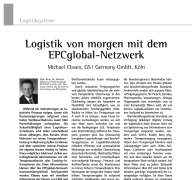
Tomorrow’s Logistics with the EPCglobal Network

Tomorrow’s Logistics with the EPCglobal Network

Michael Clasen
Due to growing demands on logistic processes, increasing transportation costs and a crowded, highly competitive market, margins in this service sector are shrinking. In order to survive, logistics providers will have to reduce internal costs, for example by means of logistic optimization (e.g., scheduling of pickup and delivery). Equally important, they also need to offer their customers additional value-added services, such as tracking and tracing (e.g., temperature logging within the cold chain). These requirements can be seamlessly supported across multiple industries by the event-driven EPCglobal Network.
Industrie Management | Volume 23 | 2007 | Edition 1 | Pages 68-71
1 4 5 6 7