Augmented Reality

Human-Machine-Interaction in Selfoptimizing Production Systems

Human-Machine-Interaction in Selfoptimizing Production Systems

Barbara Odenthal, Marcel Ph. Mayer, Wolfgang Kabuß, Jan A. Neuhöfer, Bernhard Kausch, Christopher M. Schlick
The Cluster of Excellence “Integrative Production Technology for High-Wage Countries”, funded by the German Research Foundation, at the RWTH Aachen University develops solutions to improve the competitiveness of production in Germany. In the future, production systems should be capable of independently adapting to new conditions as a result of the development of cognitive controls, e.g., for robot-aided assembly processes. The tasks of the human operator will thereby focus primarily on system monitoring and direct cooperation with robots. Based on the new requirements regarding this cognitive system, one focus is the development of an ergonomic human-machine-interface.
Industrie Management | Volume 25 | 2009 | Edition 2 | Pages 21-24
New Ways for effective Supply Network Planning

New Ways for effective Supply Network Planning

Dynamische Verfügbarkeitsplanung mit Hilfe von Assistenzsystemen
Michael Toth, Axel Wagenitz
Globalization led to a continuous increase of international sourcing-strategies. The saving potentials that can be realized with these strategies are however bought with less flexibility and high order lead times. In order to support the expediter in planning and controlling global supply chains, a holistic approach has been developed in order to show disposable inventories in the supply network and to make future inventory level changes transparent for the expediter and the sales department. The basis for this solution is a variable assistant system framework which makes a dynamic stock range monitoring possible and therefore offers available-to-promise (ATP) functionalities for global supply relations.
Industrie Management | Volume 25 | 2009 | Edition 2 | Pages 55-58
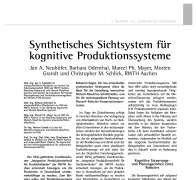
Development of a Synthetic Visual System for Cognitive Production Systems

Development of a Synthetic Visual System for Cognitive Production Systems

Jan A. Neuhöfer, Barbara Odenthal, Marcel Ph. Mayer, Morten Grandt, Christopher M. Schlick
The Cluster of Excellence “Integrative Production Technology for High-Wage Countries”, funded by the German Research Foundation, at the RWTH Aachen University develops solutions to improve the competitiveness of production in Germany. In the future, production systems should be capable of independently adapting to new conditions as a result of the development of cognitive controls, e.g., for robot-aided assembly processes. The tasks of humans will thereby focus primarily on system monitoring and direct cooperation with robots. A system developed at the IAW serves as the foundation for the design of AR-based user interfaces for computer-supported planning of human-robot cooperation processes.
Industrie Management | Volume 24 | 2008 | Edition 4 | Pages 33-36
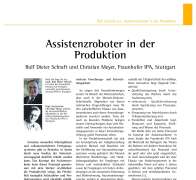
Assistant Robots for Production

Assistant Robots for Production

Rolf Dieter Schraft, Christian Meyer
Between the manual workplace and highly automated production systems there are niches, in which the degree of automation can be increased by new concepts. The concept of assistant robots can explore these potentials together with the worker: increasing productivity and flexibility regarding lot sizes and product variants. Simples systems are being used today, for example in trajectory controlled handling of heavy workpieces. Systems with a high degree of interaction between man and machine are in the need of further research and development. Nowadays, challenges are in the area of safety, but also in the man machine interface. Apart from these technical questions the area of application has to be broadened to guarantee an economic use of assistant systems. In spite of these problems evaluations show that lots of manufacturers and users of automation systems see great potentials in this line of development.
Industrie Management | Volume 22 | 2006 | Edition 2 | Pages 17-20
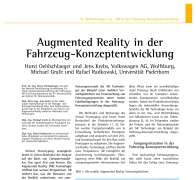
Augmented Reality in the Field of Automobile Advance Development

Augmented Reality in the Field of Automobile Advance Development

Horst Oehlschlaeger, Jens Krebs, Michael Grafe, Rafael Radkowski
In many applications Virtual Prototyping allows for an analysis based on computer models reducing time and cost. The Augmented Reality technology offers new potentials for virtual prototyping by augmenting a user’s view on real objects with additional computer generated information. In analogy to hardware in the loop techniques it is possible, e.g., to jointly analyse already existing and virtual components of a system currently under development. In this paper we describe the application and potential benefits of AR-technologies. As an example we present a mobile test platform for the analysis and evaluation of automotive ergonomics under real driving condi-tions in the field of automobile advance development.
Industrie Management | Volume 21 | 2005 | Edition 2 | Pages 31-34
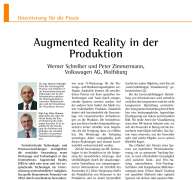
Augmented Reality in Production

Augmented Reality in Production

Werner Schreiber, Peter Zimmermann
Modern factories are heavily influenced by product technologies, processes, IT tools and by the behaviour of the markets. Therefore these factories have to change accordingly using new tools and technologies. As such, Augmented Reality (AR) is a new and promising technology to support different tasks within the factories. The large economic potential of the AR technology is verified through different applications and justifies the efforts for further hardware and software development.
Industrie Management | Volume 19 | 2003 | Edition 6 | Pages 32-34
Integrating Workers into Production with IT

Integrating Workers into Production with IT

Potential Use of Multimedia, Augmented Vision and Augmented Reality
Michael F. Zäh, Christian Patron, Volker Weber
The meaning of humans as a most important and most valuable production factor is today uncontested. Humans in production are characterised by flexibility, creativity and a high potential of problem solving. The worker must be supported with suitable information technology in order to fulfil tasks under turbulent conditions. A “just-in-time” delivery is nowadays sche-duled only for the material, not for the information. The objective is to support humans in production as efficiently as possible with relevant information, at the correct place, the correct time and in the appropriate quality. To use these new potentials, technologies such as Multimedia, Augmented Vision (AV) and Augmented Reality (AR) have been developed. In the following contribution, the potentials of these technologies are shown and applications will be presented.
Industrie Management | Volume 19 | 2003 | Edition 6 | Pages 13-16
1 4 5