Additive Manufacturing

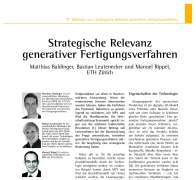
Strategic Relevance of Additive Manufacturing

Strategic Relevance of Additive Manufacturing

Matthias Baldinger, Bastian Leutenecker, Manuel Rippel
Additive manufacturing is today increasingly used to produce final products and not only prototypes in product development. Like many technologies before breakthrough it is mainly applied in niche markets, where it is overcoming its current limitations. Afterwards, it has the potential to transform industries as MP3 and iPod have done with the music business. The economist even speaks of the next industrial revolution [1]. This article supports companies in evaluating the strategic implications of additive manufacturing of final products in the mid- to long-term.
Industrie Management | Volume 29 | 2013 | Edition 2 | Pages 11-14
Future Customization  Interdisciplinary Basic Research in the SFB 814

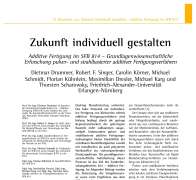
Future Customization Interdisciplinary Basic Research in the SFB 814

Additive Manufacturing
Dietmar Drummer, Robert F. Singer, Carolin Körner, Michael Schmidt, Florian Kühnlein, Maximilian Drexler, Michael Karg, Thorsten Scharowsky
The increasing complexity of technical components and shorter product life cycles make high demands on the flexibility and the efficiency of production processes. Additive manufacturing processes comply with this requirement profile. So far, these methods particularly in the desktop prototyping and manufacturing are common. The undisputed high potential for individual production of small batches by means of additive manufacturing processes is so far due to the low reproducibility of the manufactured components not been fully utilized in terms of a rapid manufacturing. Especially powder- and beam-based additive manufacturing technologies offer in terms of recoverable component strengths with both metallic and polymeric materials have a promising range of applications. The basic scientific study of this process is the goal of the Collaborative Research Centre 814 Additive Manufacturing (SFB 814). In the following article, aims and initial results from the SFB 814 are shown.
Industrie Management | Volume 29 | 2013 | Edition 2 | Pages 33-38
When Tools Start to Radio

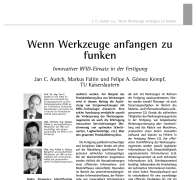
When Tools Start to Radio

Innovative RFID application in manufacturing processes
Jan C. Aurich, Markus Faltin, Felipe A. Gómez Kempf
The ongoing development of Radio Frequency Identification (RFID) opens up new possibilities to parallelize information and material flows. Manufacturing processes can be provided with real time information and new lifecycle services (e.g. definition of optimal cutting parameters, life cycle data, etc.) can be realized. In this paper the advantages of RFID on metal cutting tools are discussed. RFID on tools can support an efficient tool management and help to automate manual activities within the manufacturing process.
Industrie Management | Volume 25 | 2009 | Edition 5 | Pages 23-26
Protecting Analogue Goods by Digital Watermarking

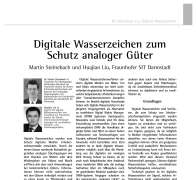
Protecting Analogue Goods by Digital Watermarking

Martin Steinebach, Huajian Liu
Digital watermarking has been developed for copyright protection and fighting piracy in the domain of digital media. Due to recent improvements regarding watermarking robustness against printing of images or analogue distribution of audio and video, also the protection of common, non-virtual goods has been enabled. Information can transparently be linked with the goods, providing a protective layer hard to forge or to remove. We discuss recent developments in the area of image watermarking and introduce an algorithm suitable for printing and scanning of packages. Additionally we show typical challenges and solutions for image watermarking caused by typical analogue transformations of marked content.
Industrie Management | Volume 24 | 2008 | Edition 6 | Pages 55-58
1 4 5