virtualization

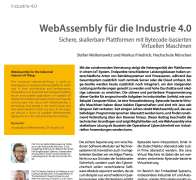
WebAssembly for the Industrial Internet-of-Things

WebAssembly for the Industrial Internet-of-Things

Sichere, skalierbare Plattformen mit Bytecode-basierten Virtuellen Maschinen
Stefan Wallentowitz, Markus Friedrich
The industrial internet-of-things is built on heterogeneous hardware/software platforms, which vary in their architecture and performance. Virtualization is an important technology for building secure and portable applications on scalable IoT deployments. Bytecode based virtual machines are coming back into focus with WebAssembly, a technology that started in the web browser and now raises interest in other use cases. In this paper we discuss a vision of scalable WebAssembly deployments in the industrial internet-of-things.
Industrie 4.0 Management | Volume 39 | 2023 | Edition 3 | Pages 48-51 | DOI 10.30844/IM_23-3_48-51
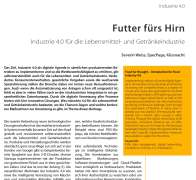
Food for thought – Introduction for Food Industry 4.0

Food for thought - Introduction for Food Industry 4.0

Severin Weiss
Implementing Industry 4.0 as the digital Agenda in all manufacturing industries and thereby increasing the competitiveness is a matter of course and clearly also applicable for the food and beverage industry. With altering customer behaviours, legal requirements as well as the increasing specialization, the industrial sectors are facing continuous challenge. Even though the automation of facilities in many cases is already put into practice, the structured integration into a holistic data concept is often missing. Through the digital networking of all processes, innovative solutions are on offer. What does Industry 4.0 mean for the food and beverage industry, where the opportunities lie and which specific implementation measures are available is subject to this article.
Industrie 4.0 Management | Volume 34 | 2018 | Edition 5 | Pages 55-58 | DOI 10.30844/I40M18-5_55-58
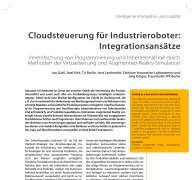
Control as a Service for Industrial Robots

Control as a Service for Industrial Robots

Vereinfachung von Programmierung und Inbetriebnahme durch Methoden der Virtualisierung und Augmented-Reality-Simulation
Jan Guhl, Axel Vick, Jens Lambrecht, Jörg Krüger
The methods presented allow the splitting of classic monolithic numerical controls of industrial robots and machine tools into their functional units. The core functionalities can then be brought onto different computers in even separate places. Using techniques of augmented reality allows enriching a captured scene with additional information, as a virtual model of the industrial robot or the planned paths. Combining these approaches leads to a simplified programming task for industrial robots as the programs can be visualized in their context. This decreases setup time and improves quality.
Industrie 4.0 Management | Volume 32 | 2016 | Edition 2 | Pages 7-10
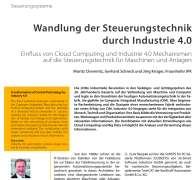
Transformation of Control Technology by Industry 4.0

Transformation of Control Technology by Industry 4.0

Einfluss von Cloud Computing und Industrie 4.0 Mechanismen auf die Steuerungstechnik für Maschinen und Anlagen
Moritz Chemnitz, Gerhard Schreck, Jörg Krüger
The third industrial revolution culminated in the Computer Integrated Manufacturing but limited computing power and the dystopia of a deserted factory prevented its success. Industry 4.0, however, stands for the integration of people, technology and organization. Based on the networking of products, tools and means of production become all relevant information available. The combination with cloud computing and big data enables the analysis and utilization of such information.
Industrie Management | Volume 31 | 2015 | Edition 6 | Pages 16-19
Matching Virtual and Real Supply Chain Objects

Matching Virtual and Real Supply Chain Objects

An Approach to Match Research Environments in Logistics
Michael Lawo, Tobias Warden, Dieter Uckelmann ORCID Icon, Dirk Werthmann
To evaluate research approaches in logistics, tests are indispensable. For enhanced research in logistics worldwide well established labs could take a major role to shorten development cycles. However, often remote access to necessary resources in the different labs is not possible. In this context a new opportunity for a technology driven access to supply chain labs could be established to increase the availability and user friendliness as well as the utilization rate of existing infrastructures. In the present article the remote access through a web based interface is introduced. The system has been developed within a two year student project in collaboration with the computer science and production engineering department at the University of Bremen.
Industrie Management | Volume 28 | 2012 | Edition 1 | Pages 45-48