sustainability

Sustainability in Logistics

Sustainability in Logistics

Measurability of ecological and social criteria and the integration of supply chain partners
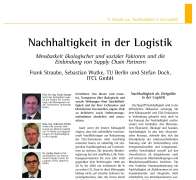
Frank Straube, Sebastian Wutke, Stefan Doch
Increasing customer demand and legislative regulations on sustainability lead to growing pressure on companies to provide transparency on the negative social and ecological effects of their business activities and those of their suppliers and service providers. A broad strategic integration of sustainability, incorporating economic, social and ecological aspects, enables companies to gain a competitive advantage. Several standards provide support for the measurement and reporting of ecological and social indicators, though the quantification of social sustainability still remains a challenge. For improving sustainability effectively, the scope of measurement and target setting has to include supply chain partners like suppliers or service providers. Top performing companies include sustainability criteria in their procurement processes for logistics services to reduce their transport-related emissions effectively.
Industrie Management | Volume 29 | 2013 | Edition 5 | Pages 7-10
Changeability as Enabler for Sustainable Logistics

Changeability as Enabler for Sustainable Logistics

IT-Tool zum Nachhaltigkeitstrendmonitoring und Wandlungsagent
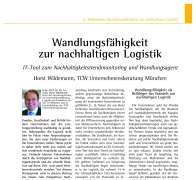
Horst Wildemann
Customers, society and politics challenge companies to ensure the sustainability of their value creation. Many stakeholder groups have an eye on the logistics. These groups constantly raise new requirements and regulations affecting companies’ businesses.  This is the reason why it is not sufficient anymore to react on changing requirements. Companies can gain competitive advantages if they anticipate trends in sustainability and react immediately. In this context, this article presents an approach for trend monitoring and a change agent suppor-ting to react effectively and efficiently on trends in sustainability.
Industrie Management | Volume 29 | 2013 | Edition 5 | Pages 35-38
Energy Value Stream Mapping as a Tool of the Digital Factory

Energy Value Stream Mapping as a Tool of the Digital Factory

Sustainable Optimization with Simulative Energy Value Stream Mapping
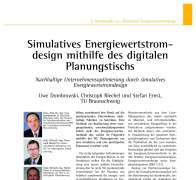
Uwe Dombrowski, Christoph Riechel, Stefan Ernst
Rising energy costs, the changing political context as well as growing customer requirements are increasing the pressure on manufacturing companies to run sustainable factories. A method to realize an energy efficient factory is the Energy Value Stream Mapping. This paper shows an approach which adds a simulative and participative dimension to the method by using the IFU planning table.
Industrie Management | Volume 28 | 2012 | Edition 6 | Pages 55-58
Target Allowance, CO2-Controlling for a Sustainable Production Strategy

Target Allowance, CO2-Controlling for a Sustainable Production Strategy

CO2-Controlling für eine nachhaltige Produktionsstrategie
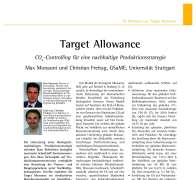
Max Monauni, Christian Freitag
Heading for an ecological production, precise specifications regarding a maximal amount of harmful substances emitted is needed. By defining a quantifiable goal for carbon dioxide on product component level, a precise evaluation of the current product-portfolio’s sustainability becomes feasible. Therefore incorrect practices on shop floor level can be observed and eliminated by appropriate and cost-efficient concepts. A structured calculation model for quantifying the sustainable carbon dioxide emission over the entire product life cycle is being developed: the Target Allowance. This enables production systems to implement ecological minimum requirements oriented on the absolute, global maximum loading.
Industrie Management | Volume 28 | 2012 | Edition 5 | Pages 41-44
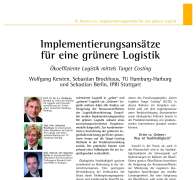
Implementing Greener Logistics

Implementing Greener Logistics

Ökoeffiziente Logistik mittels Target Costing
Wolfgang Kersten ORCID Icon, Sebastian Brockhaus, Sebastian
Following increasing public demand, sustainability is currently on the agenda of every company. In particular for logistics, environmental considerations play an important role today. This manuscript will put forward the concepts of “green” and “greener” logistics and highlight the differences between the two. “Greener logistics” encompasses all approaches dedicated to increasing the resource efficiency of logistics processes. In this article a practical guide to implementing greener logistics will be outlined. In order to ensure customer focus, a target costing approach is suggested. Practical relevance is demonstrated with a case study.
Industrie Management | Volume 27 | 2011 | Edition 6 | Pages 57-60
Sustainable Cooperation in Logistics Networks

Sustainable Cooperation in Logistics Networks

Lösungsbausteine zur Bewertung des grünen Einsatzes von Logistikkonzepten
Volker Stich, Jan Helmig
The importance of sustainable planning and managing of networks by logistics concepts is rising. However, estimating these logistics concepts under sustainability aspects is a problem which many logistics managers have to face. The impact of logistics concepts to the target figures in a sustainable performance measurement system highly depends on the correlation between the variables. In this paper the correlation between the target figures within the functional areas of procurement, production, distribution and service are depicted. Based on these findings a cross-functional causal loop diagram is derived.
Industrie Management | Volume 27 | 2011 | Edition 6 | Pages 69-72
Sustainability as a Logistic Challenge: Potentials and Barriers

Sustainability as a Logistic Challenge: Potentials and Barriers

Potenziale und Barrieren
Wolf-Rüdiger Bretzke
The current discussion on sustainability lacks a firm foundation on a clear and unambiguous definition of this pivotal concept. This impedes a concentrated discussion among scientists as well as politicians and managers on a subject-matter concerning the future of mankind. It gives room for hollow commitments of companies claiming publicly to be „green“. The article therefore starts by proposing a clear and unambiguous definition which can fill this gap. Based on this preliminary work the author argues that logistics cannot become sustainable if it remains in a position where it only has to ensure the demands of other departments’ means (especially those of marketing) thus neglecting fundamental interdependencies. Logisticians often claim systems thinking as the dominant perspective of their work. Based on a practical example the author shows that systems thinking can only work as a door opener to sustainability if it is applied to the company as a whole.
Industrie Management | Volume 27 | 2011 | Edition 6 | Pages 65-68
Technology-Index for Developing Sustainability in Logistics Processes

Technology-Index for Developing Sustainability in Logistics Processes

Frank Straube, Arnfried Nagel, Stefan Doch
The evidence of the ecological sustainability of logistics systems is increasingly expected by customers inside and outside the supply chain. Companies can affect their carbon footprint at different strategic levels: products, structures, processes and technologies. The potential use and evaluation of technologies and their contribution to improve ecological sustainability while taking into account economic conditions are the subject of this paper.
Industrie Management | Volume 27 | 2011 | Edition 6 | Pages 61-64
Sustainable Supply Chain Management

Sustainable Supply Chain Management

Assessment of the Sustainable Application of Logistic Concepts in Corporate Networks
Jan Helmig, Jerome Quick, Henrik Wienholdt, Kerem Oflazgil
Since the turn of the millennium companies are confronted with a tightly interwoven network consisting of changed framework conditions. Thus, for many companies it is necessary to form a network, together with a simultaneous securing of liquidity. Additionally, it is important to consider ecological values. The selection of adequate concepts in the supply chain management in combination with the right extent in logistic services poses a major challenge. However the dynamic assessment and selection of logistic concepts is quite possible. This article presents such an approach.
Industrie Management | Volume 26 | 2010 | Edition 5 | Pages 58-60
Intellectual Capital: Your Future Assets

Intellectual Capital: Your Future Assets

Reporting and Development of Intangible Assets
Katja Pook
Corporate success depends increasingly on immaterial assets. These are hard to assess, evaluate and shape. Only a few companies manage them systematically. Intellectual Capital Reporting provides a framework and opens the way for sustainable management of intangible assets.
Industrie Management | Volume 22 | 2006 | Edition 6 | Pages 45-46
1 6 7 8