risk management

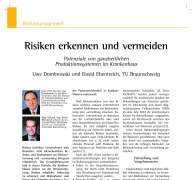
Recognize and Avoid Risks

Recognize and Avoid Risks

Potenziale von ganzheitlichen Produktionssystemen im Krankenhaus
Uwe Dombrowski, David Ebentreich
Risks threaten companies in all industries. Especially, if lives are threatened companies have to take measures for risk detection and prevention. The healthcare industry and especially hospitals have to identify risks as early as possible to take measures to protect patients. For this purpose the methods and tools from the lean production system can support hospital employees. Therefore, this paper analyses the support of lean production systems for improving patient safety in hospitals.
Industrie Management | Volume 30 | 2014 | Edition 5 | Pages 62-66
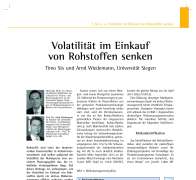
Reducing the Purchase Price Volatility of Commodities

Reducing the Purchase Price Volatility of Commodities

Timo Six, Arnd Wiedemann
Commodity prices are one of the key cost drivers in industrial enterprises. Due to the volatility of market prices they hold a significant risk for potential losses. The purpose of this paper is to demonstrate how a purchase department can reduce the volatility of commodity prices by implementing an active risk management. It is shown how to carry out a systematic review and assessment of commodity price risks and how to smooth short-term price fluctuations by using effective instruments.
Industrie Management | Volume 30 | 2014 | Edition 5 | Pages 7-11
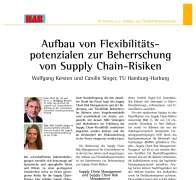
Implementing Flexibility to Manage Supply Chain Risks

Implementing Flexibility to Manage Supply Chain Risks

Wolfgang Kersten ORCID Icon, Carolin Singer
Nowadays, the economic determining factors are volatile and change dynamically leading to high uncertainty and risk for supply chain partners. Increased supply chain flexibility is not only considered as a success factor but is also essential for companies to remain competitive. The present article is based on selected results from expert interviews, a focus group as well as a survey analysing the status quo concerning supply chain risk management and the importance of flexibility. Afterwards, a process model is presented which consists of an approach to deduct strategies and measures in order to adjust supply chain flexibility in a structured way. The approach can be implemented for risk mitigation in practice.
Industrie Management | Volume 27 | 2011 | Edition 3 | Pages 61-64
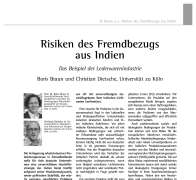
Risk Associated With Sourcing From India

Risk Associated With Sourcing From India

the Case of the Leather Industry
Boris Braun, Christian Dietsche
The shift of production capacities from high-cost countries to India offers new business opportunities, but also new challenges. As shown by the example of the leather industry, sourcing from India is often associated with versatile risks. Risks are especially due to transcultural misunderstandings, lacking adherence to delivery dates, low quality standards, residues of harmful substances in products as well as problematic working conditions in Indian factories and high levels of environmental pollution. German companies which are planning to source finished or unfinished goods from India should consider sustainable risk mitigation strategies right from the start in order to avoid unpleasant surprises. Comprehensive coordination of the supply chain and the installation of effective control mechanisms may prove necessary to fully exploit the business opportunities provided by Indian suppliers. However, a thorough coordination of the supply chain will not only reduce individual business ...
Industrie Management | Volume 25 | 2009 | Edition 6 | Pages 59-62
How to Manage Big Risks in Small Enterprises

How to Manage Big Risks in Small Enterprises

Roman Boutellier, Adrian Fischer, Günther Nicolussi
Many technology-driven small and medium sized enterprises (SMEs) face a delicate problem: How should they deal with risks associated with the dynamic changes in sales and supply markets? How to avoid missing out on technological advances? Which approaches for managing risks exist that suit the available resources of SMEs? Which risks can the company cope with, which ones are life-threatening? The presented practical example points out how a SME can successfully manage business risks.
Industrie Management | Volume 24 | 2008 | Edition 1 | Pages 51-54
Risiko-Controlling / Risk Controlling

Risiko-Controlling / Risk Controlling

Dieter Specht, Christian Mieke
Firms are acting more and more in networks, especially in industrial supply chains. Planning and controlling activities are realized in that supply chains e.g. for optimization of inventories. Apart from such advantages there are special risks in supply chains. In that case it is necessary to detect, to estimate and to regulate risks. Processes of control, alignment and regulation are not defined and established so far.
Industrie Management | Volume 23 | 2007 | Edition 6 | Pages 17-20
Available to Promise: On the way to Resilient Supply Chains

Available to Promise: On the way to Resilient Supply Chains

Auf dem Weg zu belastbaren Lieferterminen
Wolf-Rüdiger Bretzke
„Available to Promise“ can be regarded as the core concept of Supply Chain Management. It has become an integer part of modern software tools like SAP/APO and is being implemented in a growing number of companies. The author works out the potentialities and possible limitations of this concept and explains what remains to be done in order to make this risk management approach complete.
Industrie Management | Volume 23 | 2007 | Edition 5 | Pages 79-81
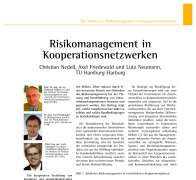
Risk Management in Cooperation Networks

Risk Management in Cooperation Networks

Designing inter-organizational value-adding processes
Christian Nedeß, Axel Friedewald, Lutz Neumann
The cooperative production of industrial goods and services in networks is a key success factor for a large number of companies. However, inter-organisational cooperation does not only lead to new opportunities in a competitive environment but additional risks can also arise. These risks have to be assessed and controlled by a systematic deployment of advanced risk management methods during all phases of a cooperation’s life cycle. Therefore, this article shows which approaches should be chosen and which constraints have to be considered.
Industrie Management | Volume 22 | 2006 | Edition 3 | Pages 29-32
Preventive Operation Strategies for Ramp-up

Preventive Operation Strategies for Ramp-up

Horst Wildemann
Approaches for a risk oriented ramp-up management can suit the purpose of closing the methodical gap between project management and production management. To develop management strategies for a risk oriented ramp-up management central ramp-up risks for a green field plant have been identified in the first step. A risk oriented scenario model leads to a quantification of possible effects resulting from the identified risks. To reach the goal of creating a ramp-up robust production system management strategies have been derived as constitutional elements of a preventive risk management. The management strategies aim at a minimisation as well as transformation of technical and organisational risks.
Industrie Management | Volume 20 | 2004 | Edition 4 | Pages 17-20
Risk Management in Production Ramp-Up

Risk Management in Production Ramp-Up

Michael F. Zäh, Niklas Möller
For successful new product introductions in a highly competitive market the performance of future production ramp-ups has to be increased. Solving emerging problems efficiently is a necessity for the reduction of total costs and time of the manufacturing start-up period. A specific risk management allows the measurement of potential problems arising in the ramp-up process. Based on this knowledge, it is determined in which specific area a detailed scenario planning promises higher gains than efforts.
Industrie Management | Volume 20 | 2004 | Edition 4 | Pages 13-16
1 2 3