production ramp-up

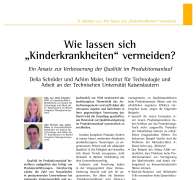
How to Prevent “Teething Problems”?

How to Prevent “Teething Problems”?

An Approach to Improve the Production Ramp-Up
Delia Schröder, Achim Maier
Quality in the production ramp-up significantly affects the success of new product introductions. At the same time the number of restarts in producing companies grows with more divers and specific customer requirements and less vertical range of onsite manufacturing. The resulting complexity is difficult to manage and often leads to quality issues. This article tackles the problem by focusing on quality aspects of the ramp-up management. Based on a holistic understanding of quality the authors present „PAM“, a model for production ramp-up. PAM structures the highly complex topic of ramp-up management and at the same time represents all relevant interdependent elements. The model provides a basis to systematically improve quality in production ramp-up.
Industrie Management | Volume 26 | 2010 | Edition 4 | Pages 29-32
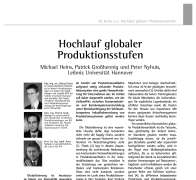
Ramp-up of Global Production Stages

Ramp-up of Global Production Stages

Michael Heins, Patrick Großhennig, Peter Nyhuis ORCID Icon
Today globalization is a common challenge companies have to cope with. Cost aspects are still playing an essential role in this context. To ensure a long-term profitability, companies also have to consider non-monetary factors like core-competences. Besides globalization the increasing rate of ramp-ups caused by decreasing product life-cycles is a big challenge for companies. This article will introduce approaches to deal with the conflict of objectives between cost-reduction, safe-guarding of core-competences and ramp-up of production systems.
Industrie Management | Volume 23 | 2007 | Edition 3 | Pages 55-58
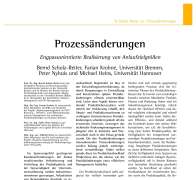
Process Changes – Obstacles during Run-Up of Production Systems

Process Changes - Obstacles during Run-Up of Production Systems

Bernd Scholz-Reiter ORCID Icon, Farian Krohne, Peter Nyhuis ORCID Icon, Michael Heins
In the conflict between greater customer requirements and a diversification in production industry, companies are forced to reduce ramp-up times significantly. The trend towards a continuous reduction of the time-to-market puts pressure on these companies and addresses the realisation of the expected market entry. More often this results in an inefficient production run-up, because the reduction in development time poses an important factor for later product changes. With regard to shorter product life cycles, it is expected that time for production and distribution will be extended. Cost-intensive product changes will reduce profit, which is why product change management becomes more and more important. Nevertheless, the effective management of process changes is not addressed sufficiently by today’s research. These in particular can be defined as most critical factors for an efficient production run-up.
Industrie Management | Volume 22 | 2006 | Edition 6 | Pages 15-18
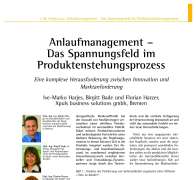
Ramp-up Management – Area of Conflict in the Product Development Process

Ramp-up Management - Area of Conflict in the Product Development Process

Eine komplexe Herausforderung zwischen Innovation und Marktanforderung
Ive-Marko Harjes, Birgitt Bade, Florian Harzer
An increasing customer-driven rate of individualisation as well as the lack of brand loyalty is leading to a greater competition within the automotive industry. Project organisations integrate innovations and technologies into the product under enormous permanent pressure. Especially the defined targets concerning time-to-market, costs, and quality set new challenges to the project management throughout the often decentralised innovation network of engineering partners and manufacturers.
Industrie Management | Volume 20 | 2004 | Edition 4 | Pages 45-48
Risk Management in Production Ramp-Up

Risk Management in Production Ramp-Up

Michael F. Zäh, Niklas Möller
For successful new product introductions in a highly competitive market the performance of future production ramp-ups has to be increased. Solving emerging problems efficiently is a necessity for the reduction of total costs and time of the manufacturing start-up period. A specific risk management allows the measurement of potential problems arising in the ramp-up process. Based on this knowledge, it is determined in which specific area a detailed scenario planning promises higher gains than efforts.
Industrie Management | Volume 20 | 2004 | Edition 4 | Pages 13-16