production management

Challenges in Dealing with Production Disturbances

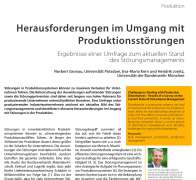
Challenges in Dealing with Production Disturbances

Results of a survey on the current state of disturbance management
Norbert Gronau ORCID Icon, Eva-Maria Kern, Hendrik Jonitz
Current State of Disturbance Management Disturbances in production systems can lead to massive costs for enterprises. It is a highly relevant ability for manufacturing companies to cope with the effects of occurring disturbances and their prevention. A survey on manufacturing companies draws a current picture of disturbance management and identifies challenges for coping with disturbances.
Industrie 4.0 Management | Volume 35 | 2019 | Edition 6 | Pages 33-36 | DOI 10.30844/I40M_19-6_S29-32
Efficient Simulation in Production Management

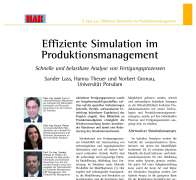
Efficient Simulation in Production Management

Schnelle und belastbare Analyse von Fertigungsprozessen
Sander Lass, Hanna Theuer ORCID Icon, Norbert Gronau ORCID Icon
In the research project LUPO a hybrid simulation laboratory is build up. This combines the advantages of the computer simulation with those of a model factory. For the systematic recording, mapping and analysis of various production processes a procedure model has been created that responds to the special requirements (quick, flexible, effortless determination of informative results) of the project. A library of production objects facilitates the reutilisa tion of existing machines and hereby a reduction of simulation effort.
Industrie Management | Volume 27 | 2011 | Edition 3 | Pages 13-15
Hybrid Simulator – A New Production Management Approach

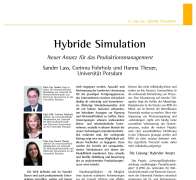
Hybrid Simulator - A New Production Management Approach

Neuer Ansatz für das Produktionsmanagement
Sander Lass, Corinna Fohrholz, Hanna Theuer ORCID Icon
In a world of steady change, manufacturing companies face major challenges. They have to react quickly to an increasing competition and more and more individual customer requests. New technologies and organisational structures like RFID or decentralised and real-time based production control can deal with this issue successfully. The specific realization of selection and analysis of each production process of the company often approves to be difficult and cost intensive. Previous simulation approaches are frequently combined with high efforts in order to state credible propositions regarding suitability and economic efficiency. The present paper shows a new opportunity towards managing these disadvantages. Additionally, the advantages are combined with computer-based simulations of the model factory. A fast and flexible illustration of the analysed production processes is achieved.
Industrie Management | Volume 27 | 2011 | Edition 1 | Pages 13-16
Implementing the Production Operating Curves into Production Controlling of an Electronics Manufacturing Plant

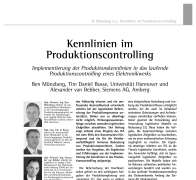
Implementing the Production Operating Curves into Production Controlling of an Electronics Manufacturing Plant

Implementierung der Produktionskennlinien in das laufende Produktionscontrolling eines Elektronikwerks
Ben Münzberg, Tim D. Busse, Alexander van Bebber
Today, the logistics performance especially of manufacturing companies is becoming a distinctive success factor in the marketplace. Perceiving this development Siemens’ Electronics Manufacturing plant in Amberg (EWA) implemented a comprehensive logistics KPI system supporting the controlling of production processes. The tools used, however, fall short of considering the interdependencies between different logistics KPIs. The article reports on a project conducted in cooperation between EWA and the Institute for Production Systems and Logistics of Leibniz University at Hannover. Presenting the project’s approach, conclusions and resulting experiences, the theoretical background as well as the fundamental impact production operating curves can offer for the competitiveness of a manufacturing company are outlined.
Industrie Management | Volume 25 | 2009 | Edition 5 | Pages 43-46
Integrated Phase-out Management

Integrated Phase-out Management

Requirements of a Targeted Information System for an Efficiently Execution of Run-out Processes
Bernd Scholz-Reiter ORCID Icon, Benedikt Baumbach, Farian Krohne
In recent years dynamics in the automotive industry has increased rapidly. Beside a higher degree of customer orientation product life cycles become continuously shorter, whereby an over-all effect on Ramp-up and Phase-out Management can be stated. Because of an increasing amount of new model ranges Ramp-up Management has been well discussed during the last few years. In contrast, discussions about an efficient Phase-out Management are mostly still missing. This paper presents an approach focusing on the transparency of information considering the requirements of Production Phase-outs.
Industrie Management | Volume 24 | 2008 | Edition 5 | Pages 74-79
The Independencies Map, a Tool to Manage Complexity in Production Systems

The Independencies Map, a Tool to Manage Complexity in Production Systems

Gunter Lay, Christoph Zanker
With the implementation of numerous modernization concepts an increasingly complicated system has emerged in the companies. Single concepts partly overlap or redundantly pursue similar targets under different headings. Some concepts even compete in their target dimensions. The tool Independencies Map systematically analyzes the correlation of existing concepts and searches for inconsistencies and incompatibilities between these concepts. This article presents a pragmatic tool, which is also applicable for small and medium enterprises thus enabling them to remove efficiency barriers by harmonizing the interaction of the individual concepts.
Industrie Management | Volume 23 | 2007 | Edition 6 | Pages 37-40
Logistic Stock Analysis and Validation of Planning Methods

Logistic Stock Analysis and Validation of Planning Methods

Project results from the Siemens AG electronics plant in Amberg
Tim D. Busse, Matthias Schmidt, Felix S. Wriggers
The strategically appropriate dimensioning of inventory in the process chain is of utmost importance for companies. In this context inventory is utilized to counterbalance variations of the behaviour of customers as well as delivery date or quantity deviations caused by suppliers. It is a huge challenge to dimension the inventory as to realize a high level of security but also low stocks. This article demonstrates the methodical approach, the outcome of the Logistic Stock Analysis, and the validation of planning methods showcased for a project at the electronic factory of Siemens, Amberg.
Industrie Management | Volume 23 | 2007 | Edition 5 | Pages 75-78
Improvement of Production Systems: New Methods for Optimizing the Production

Improvement of Production Systems: New Methods for Optimizing the Production

Neue Methoden zur Produktionsoptimierung
Horst Wildemann
As the core of the added value the production meets new challenges. Against the background of new trends and changing market mechanism an adjustment of existing production structures is crucial. New sources for earning money can be found in the combination of different leverages which result finally in increasing the economic value added. The objective is to find a combination of above-average performance and cost leadership and to realize these in an integrated production concept. In these redesigned production systems above-average performance is based on the overall connection between methods, people and technologies over the whole supply chain.
Industrie Management | Volume 23 | 2007 | Edition 3 | Pages 19-22
How to Globalize Production

How to Globalize Production

Eberhard Abele, Marina Dervisopoulos, Tobias Liebeck
Today, globalization is on the top of CEO’s agenda. Both, the unparalleled potential to grow into new markets as well as boosting the competitiveness of production are great opportunities making the globalization of production an imperative for successful companies. However, the risk and the complexity of that task require a dedicated approach to design, implement and manage the company’s network. Therefore, the article describes a basic project concept, major milestones and a promising scope of action for global production management.
Industrie Management | Volume 23 | 2007 | Edition 1 | Pages 14-18
Developing an IT-System for the Logistic Controlling of Production Processes

Developing an IT-System for the Logistic Controlling of Production Processes

Rouven Nickel, Markus Vogel
In cooperation with seven industrial enterprises of different branches the institute of Production Systems and Logistics developed in the course of a research project an IT-System for the Logistic Controlling of Production Processes. The project was funded by the Stiftung Industrieforschung. The IT-System supports logisticians of enterprises by the logistic controlling of production processes and by associated planning and design of improvements.
Industrie Management | Volume 22 | 2006 | Edition 4 | Pages 61-64
1 2