product development process

Quality Based Knowledge Work in the Innovation Process

Quality Based Knowledge Work in the Innovation Process

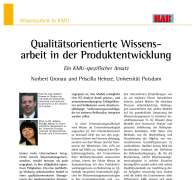
Norbert Gronau ORCID Icon, Priscilla Heinze
The growing importance of knowledge in product development processes is followed by the urgent need to manage the quality of implemented knowledge management strategies in the process. All sorts of companies have been implementing knowledge management activities in their daily routines, either or not they are aware of it. This paper introduces a model to measure the maturity level of knowledge intensive business processes, which is adjusted to the needs of small and medium enterprises (SME). A set of success factors and their indicators were developed to help identifying the as-is process situation and plan improvement measures as well as a web-based self-assessment tool.
Industrie Management | Volume 28 | 2012 | Edition 3 | Pages 12-16
Assistant for Reliable Configurations of Robot Units

Assistant for Reliable Configurations of Robot Units

Christian Peemöller, Roman Korf, Gerd Grube, Christian Mankopf
The rise of the complexity of products and the product development process in addition to shorter development cycles and the customers’ high demands on quality, increase the pressure on producing as accurately and economically as possible. Hence, it is necessary to avoid errors in the early phases of development instead of fixing them at a later stage, which can be costly. This article uses the product configuration of milling robot units to show an innovative solution for the early development phase. This approach uses established technologies from the area of semantic technologies and problem solving methods. It also shows how to improve the reliability of product configuration by making use of the expertise from later phases in the development.
Industrie Management | Volume 27 | 2011 | Edition 5 | Pages 37-40
Process-Based Knowledge Management in Product Development

Process-Based Knowledge Management in Product Development

Phasenübergreifender Wissenstransfer unterstützt den Produktentwicklungsprozess
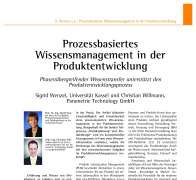
Sigrid Wenzel ORCID Icon, Christian Willmann
Preserving and re-using experience and knowledge from employees is a decisive task in industrial engineering. In this context the usage of tools for knowledge management is highly up-to-date, however a concrete implementation starts very unassertively in practise. The article discusses advisability and feasibility of a process-based knowledge management. A method of resolution in form of a knowledge infrastructure is worked out exemplary for the two phases “product planning” and “product design” linking the tools of knowledge management with knowledge-related tasks of the product development process.
Industrie Management | Volume 22 | 2006 | Edition 5 | Pages 43-46
Process of Hybrid Product Development

Process of Hybrid Product Development

Requirements in mechanical and plant engineering
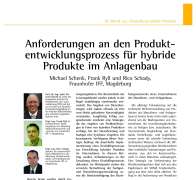
Michael Schenk, Frank Ryll, Rico Schady
Today, mechanical and plant engineering companies are already providing service bundles in the form of product-service combinations. These consist of common ranges of services, e.g. for development, customisation, operator, financing or maintenance. As a rule however, the elements of service bundles are developed separately. Moreover, the services offered are often viewed as a necessity demanded by the market. A strategy appearing to promise long-term success is pursued by offering solutions in the form of hybrid products in which service and material good form a symbiotic relationship. Rigorously pursuing this strategy entails sustainably implementing a business process to develop hybrid products in a company. This paper discusses requirements of organizing this business process. Attention is focused on a networked approach to developing material goods and services as well as the incorporation of a mechanical and plant engineering company’s network of relationships.
Industrie Management | Volume 22 | 2006 | Edition 1 | Pages 55-58