organisational learning

Knowledge Management for Industry 4.0

Knowledge Management for Industry 4.0

Herausforderungen und Lösungsansätze
Klaus North, Ronald Maier
The digital interactions along the value chain pose new challenges for managing information and knowledge. The objectives of this article are to describe the changes in knowledge-based value creation induced by digitalisation and to derive fields of action for knowledge management for Industry 4.0. The “knowledge ladder 4.0” shows how digital technologies can transform strategic and operative knowledge management. Subsequently, we offer a framework for the knowledge-oriented design of dynamic digital organisations that consists of three layers of activities for the operation, reflection and design of knowledge management illustrated with leading questions and case examples in order to promote the productive, responsible and sustainable usage of digital technologies.
Industrie 4.0 Management | Volume 35 | 2019 | Edition 2 | Pages 7-12
Informal Learning in Industry 4.0

Informal Learning in Industry 4.0

Peter Dehnbostel
The renaissance of learning at the workplace is a result of the digitization of the world of work and related new working and organizational concepts. Vocational education and training, previously dominated by seminars and training courses, changes radically in favor of learning in the work process. Will the fourth industrial revolution enhance this development? Research and development are only at the beginning, yet first answers are emerging.
Industrie 4.0 Management | Volume 32 | 2016 | Edition 3 | Pages 23-26
Knowledge Sharing and Transfer in Production Networks

Knowledge Sharing and Transfer in Production Networks

An organizational learning approach
Bernd Scholz-Reiter ORCID Icon, Salima Delhoum
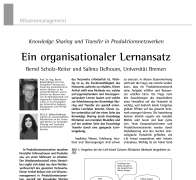
In a production network, teams or companies exchange information and products to create value. The competitive advantage of the team / company relies on that of the network. This paper addresses knowledge management in a production network especially the promotion of knowledge sharing and transfer. This is a substantial issue when, for example, a company comes to leave the network voluntarily or disappears because of natural or man-made catastrophes. In this case, the question remains whether the substituting company can acquire the tacit knowledge needed to fulfil its mission. Consequently, the operation of the network is also an acute issue. The paper proposes a methodology based on organisational and interorganisational learning and develops a learning laboratory that facilitates knowledge sharing and transfer. This lab supports, (a) knowledge sharing through the mental map’s knowledge elicitation of every company’s leader, and (b) knowledge transfer via dedicated learning-based ...
Industrie Management | Volume 23 | 2007 | Edition 4 | Pages 34-36