modularisation

Modularisation is the New Key Success Factor for Companies

Modularisation is the New Key Success Factor for Companies

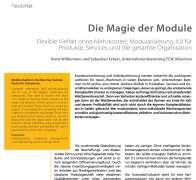
Flexible Vielfalt ohne Mehrkosten: Modularisierung 4.0 für Produkte, Services und die gesamte Organisation
Horst Wildemann, Sebastian Eckert
Customer orientation and individualization will be two of the biggest challenges for companies. They need to expect their business model to become more complex as the range and diversity of their products and services will increase. Those who find a smart approach of managing the complexity will have a decisive competitive advantage. Those who use modularization across products, services, production and the organisation, will be prepared to deliver individual value propositions more quickly and their profitability will not be jeopardised by their own complexity.
Industrie 4.0 Management | Volume 37 | 2021 | Edition 2 | Pages 52-56
Product Architecture Configuration

Product Architecture Configuration

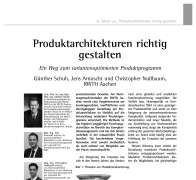
A Way to a Variant-Optimized Product Program
Günther Schuh ORCID Icon, Jens Arnoscht, Christopher Nußbaum
At the Laboratory for Machine Tools and Production Engineering (WZL) of the RWTH Aachen University, a consumer oriented conflict free and continuous configuration of the product architecture in terms of modular product program development has been developed. The Method is the result of a long year research activity in the field of complexity management and has already been repeatedly successfully applied in industry. Companies can reduce their inner complexity while simultaneously optimizing the fit with customer demands by applying the mentioned method. The described approach is demonstrated both methodically as well as with practical examples.
Industrie Management | Volume 23 | 2007 | Edition 6 | Pages 29-32
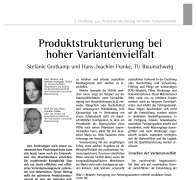
Product Structuring for Variant-Rich Production

Product Structuring for Variant-Rich Production

Stefanie Grotkamp, Hans-Joachim Franke
Today in mechanical engineering it is hardly possible to elude the demands for a variant-rich product spectrum. The resulting complexity can be reduced and controlled only by effective and efficient variant management. This article presents the product structuring as one of the central tasks of variant management in product development. The structuring determines the characteristics of the product just as the development process and has substantial influence on every process in the enterprise.
Industrie Management | Volume 23 | 2007 | Edition 6 | Pages 33-36
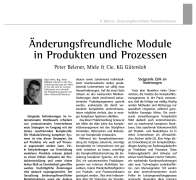
Design of Changeable Modules in Products and Processes

Design of Changeable Modules in Products and Processes

Peter Belener
petition demand new strategies in the management of an increasing complexity. Modularization of complex systems is such a strategy, practical for products and processes. However, the planning of modular structures takes place at an early stage of product development and is associated with many risks. Because of this, changes in products and processes are inevitable. Therefore, the design of an alterable module structure and effective management of module changes is the focus of the following article.
Industrie Management | Volume 23 | 2007 | Edition 3 | Pages 51-54
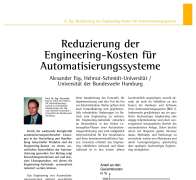
Reduction of Automation System Engineering Costs

Reduction of Automation System Engineering Costs

Alexander Fay ORCID Icon
Due to the increasing complexity of automation solutions for production and manufacturing industries, engineering costs have become a major cost factor of automation systems. The paper describes how engineering efforts can be systematically reduced.
Industrie Management | Volume 22 | 2006 | Edition 2 | Pages 29-32
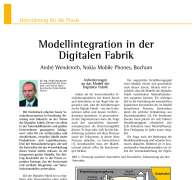
Model Integration in the Digital Factory

Model Integration in the Digital Factory

André Wenderoth
With emphasis simulation experts in research, consultancy and industry work on the vision of the Digital Factory. This catch phrase, which is especially promoted in the automotive sector, stands for a comprehensive, simulation model of real production systems and their logis-tics. One of the challenges faced by the developers in the realisation of this vision is the integration of big models. The article describes a concept, which supports the horizontal and vertical integration of simulation models.
Industrie Management | Volume 20 | 2004 | Edition 1 | Pages 48-51
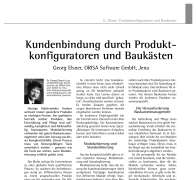
Customer Retention by using Product Configurators and Component Systems

Customer Retention by using Product Configurators and Component Systems

Georg Elsner
Todays consumer markets demand more and more specialised products at low prices. The qualitative sale of their products, as well as development and maintenance, are expensive, complicated and error-prone. Consistent modularisation, combined with good component system management, can solve this trap of complexity. This process has to be supported by powerful tools. Accordingly these tools only take effect if modularisation is reality.
Industrie Management | Volume 19 | 2003 | Edition 1 | Pages 33-36