interoperability

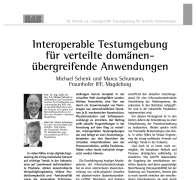
Interoperable Test Environments for Distributed Applications

Interoperable Test Environments for Distributed Applications

Michael Schenk, Marco Schumann
In many cases, digital engineering is the only realistic answer to important trends in industry. This includes increasingly customized products, decentralized value chains, increasing complexity and functionality of products as well as the need to reduce the time to market. Digital Engineering has already resulted in many technology-driven changes of the product development process. Probably the most important change is the ability to execute some of the iteration loops of development and test completely in the virtual environment. Further improvements can only be achieved by simultaneously combining development and simulation tools from many different domains, such as mechanical engineering, physics simulation, and software engineering. This article identifies current research issues in the field of distributed interoperable testing environments. Moreover, two examples of current applications are given to illustrate what functionalities can already be utilized today.
Industrie Management | Volume 25 | 2009 | Edition 2 | Pages 47-50
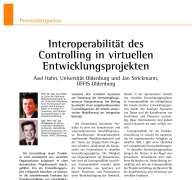
Interoperability of Controlling in Virtual Engineering Projects

Interoperability of Controlling in Virtual Engineering Projects

Axel Hahn, Jan Strickmann
The development of new complex products is increasingly conducted cooperatively in distributed, heterogeneous organisations in a dynamic environment. To successfully accomplish a project, the coordination of project controlling is of vital importance. Each participant of the development network has individual controlling systems, which cover his information and management needs. For cross-project controlling however, the creation of interoperability between distributed systems is a precondition for the coordination of processes. The article describes a cross-project controlling approach, which fosters integration by semantic modelling.
Industrie Management | Volume 21 | 2005 | Edition 4 | Pages 28-32
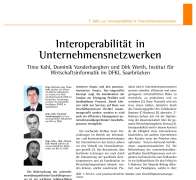
Enhancing Interoperability Within Enterprise Networks

Enhancing Interoperability Within Enterprise Networks

Integration of business process-orientation and service-orientation
Timo Kahl, Dominik Vanderhaeghen, Dirk Werth
The management of inter-organisational business processes is a crucial and necessary factor towards the economic success of an enterprise. Flexibility and manageability of processes are core requirements to interoperability. In the article, we discuss the two complementary paradigms of the service-oriented approach and of the process-oriented approach. We demonstrate how the combination of these two concepts can be used to realize flexible and manageable processes even in a cross-enterprise scenario. The main advantage of this approach is the ability to compose business processes in a flexible way without losing the instruments of an effective business process management.
Industrie Management | Volume 21 | 2005 | Edition 4 | Pages 45-48
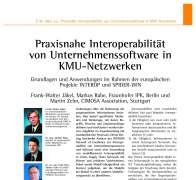
Value-Oriented Interoperability in Networked EAS

Value-Oriented Interoperability in Networked EAS

Foundations and a use case for enterprise application software
Frank-Walter Jäkel, Markus Rabe, Martin Zelm
Interoperability between ICT systems is becoming an increasingly important success factor in the cooperation of enterprises. Organisations have to exchange business information and must have the same understanding of the meaning of the exchanged information. Only then can they rely on both the transaction of the information and the validity of its contents. This paper reports on the European INTEROP Network of Excellence concerned with interoperability research for networked enterprises applications and software, its goals, rationale and early results. In addition, an application of interoperability in a supply chain network of SMEs is presented and discussed.
Industrie Management | Volume 21 | 2005 | Edition 4 | Pages 49-52
Interoperability in Supply Chains and E-Logistics

Interoperability in Supply Chains and E-Logistics

Axel Hahn
An approach to the creation of interoperability in dynamically changing supply chains is presented applying the example of transnational hazardous waste logistics. By an integral consideration of business models the integration and adaptation of the IT infrastructure is advanced.
Industrie Management | Volume 20 | 2004 | Edition 3 | Pages 67-70
1 2