Internet of things

Parameters and Challenges of Industry 4.0

Parameters and Challenges of Industry 4.0

Its implementation into German company structures
Maike Schlote, Sophia Gross-Fengels, Stefan Lier, Wiebke Baille, Sulamith Frerich
Recently, a great number of articles, book chapters, conference proceedings, and essays have been published, concerning the fourth industrial revolution or the internet of things. Unfortunately, extent and meaning of these terms become more and more unclear. Thus, a thorough understanding is necessary. Although a lot of studies are carried out to analyze potentials and threats of implementing respective elements into business, it is essential to compare expert’s perception with existing notions. In this work, both a quantitative analysis and a qualitative analysis were undertaken to identify several factors inhibiting or stimulating a further usage, by using a TOE framework. The results of both the survey and the interviews with several experts are explained in detail, and summed up into a statement of future prospects.
Industrie 4.0 Management | Volume 33 | 2017 | Edition 5 | Pages 44-48
Lean Information Logistic – a Concept for a Demand-oriented Information Logistic System

Lean Information Logistic - a Concept for a Demand-oriented Information Logistic System

Konzept für ein nachfragegesteuertes Informationslogistiksystem
Silke Hartleif, Thomas Bauernhansl, Klaus Erlach
Due to the rapid development in information technologies, the amount of information production staff has to deal with rises. Additionally, the requirements for the changeability and flexibility of control systems are growing. This leads to a constantly growing complexity in the handling of information. By avoiding unnecessary information logistics processes, this complexity is reduced and information management becomes easier.
Industrie 4.0 Management | Volume 33 | 2017 | Edition 3 | Pages 45-48
Human and Things and Data – the Interaction within the Digital Transformation

Human and Things and Data - the Interaction within the Digital Transformation

Das Zusammenspiel der digitalen Transformation
Volker Gruhn
The digital transformation is currently one of the defining topics in public discourse. New technical developments are making new services and new business models possible, though they also entail new challenges. In order to recognize and take advantage of the opportunities offered by digital transformation, it is necessary for corporate decision-makers to first understand the fundamental relationships that exist between technologies, data and customers. Only then experts are able to build on this understanding to develop new products and services. Such projects require more than just IT expertise. For the project to succeed, it is crucial that the IT and specialist divisions work together on this development. In order for the collaboration to succeed in spite of all the differences between the divisions’ remits, those in charge should ensure that the project environment is one in which all participants are able to interact on an equal footing and understand one another. The ...
Industrie 4.0 Management | Volume 32 | 2016 | Edition 2 | Pages 62-65
Industry 4.0 in Europe – A Comparison of European Initiatives

Industry 4.0 in Europe - A Comparison of European Initiatives

Ein Vergleich europäischer Industrie 4.0-Initiativen
Norbert Gronau ORCID Icon, Hanna Theuer ORCID Icon
Industry 4.0 gain in importance in recent years. Research and business realize increasingly that targeted activities in this area are necessary to preserve the market power of the industry. This article provides a summary of Industry 4.0 initiatives in ten European countries as well as their comparison based on different criteria.
Industrie Management | Volume 31 | 2015 | Edition 5 | Pages 31-34
Investing in the 3rd Industrial Revolution

Investing in the 3rd Industrial Revolution

Chancen nutzen und auf der sicheren Seite bleiben mit Anlagenfinanzierung
Kai-Otto Landwehr
Mixed global economic signs hardly allow for reliable long-term forecasts. While the traditionally export-oriented production sector in Germany is benefitting from the economic recovery in the U.S., Asian demand has started to dwindle. At the same time the third industrial revolution offers new opportunities and challenges through the development of intelligent production systems and manufacturing processes. In order to obtain an advantageous position in a changing technological and economic environment, companies must preserve efficiency and innovation in production processes. The deployment of modern technology and machinery equipment is therefore crucial. Flexible financing solutions help industrial enterprises make investments and maintain flexibility and competitive advantage.
Industrie Management | Volume 31 | 2015 | Edition 4 | Pages 53-56
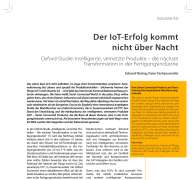
Smart Connected Products

Smart Connected Products

How they are transforming the international manufacturing industry
Eduard Rüsing
The vision is of the “Smart Connected World”, in which every “thing” in the Internet of Things has a name, can go online and can be communicated with individually via Internet. The vision can be quickly formulated, but the journey there is a rather painstaking evolution as opposed to a disruptive one. That is the result of an international study by market research experts of Oxford Economics who along with PTC researched the status of the development and the market presence of smart connected products (SCP) in the manufacturing industry. Integration and data security were named as significant challenges to be overcome on the journey into an IoT world.
Industrie Management | Volume 31 | 2015 | Edition 4 | Pages 57-60
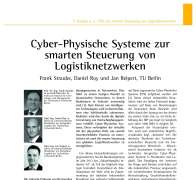
Intelligent Controlling of Logistics Networks

Intelligent Controlling of Logistics Networks

Frank Straube, Daniel Roy, Jan Reipert
Cyber-Physical Systems and the internet of things change the way we see management, production and even logistics processes. The research project “Smart Logistic Grids” uses a decentralized cloud-based management concept to reduce the risk of disruptions in logistics networks.
Industrie Management | Volume 30 | 2014 | Edition 6 | Pages 39-42
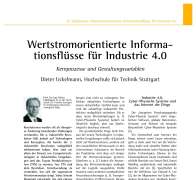
Value-Oriented Information Flows for Industry 4.0

Value-Oriented Information Flows for Industry 4.0

Kernprozesse und Gestaltungsvariablen
Dieter Uckelmann ORCID Icon
Value Stream Mapping has been applied successfully in production and logistics scenarios. With the rise of Cyber-Physical Systems (CPS) in the context of Industry 4.0, the value-contribution of information itself is gaining importance. Therefore, the concept of Value Stream Mapping is extended to the field of information logistics. Key-processes and design variables are defined.
Industrie Management | Volume 30 | 2014 | Edition 6 | Pages 13-16
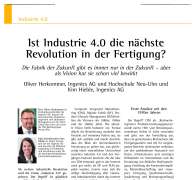
Is Industry 4.0 the Next Revolution in the Production?

Is Industry 4.0 the Next Revolution in the Production?

aber als Vision hat sie schon viel bewirkt
Oliver Herkommer, Kim Hieble
Industry 4.0 is part of the high-tech strategy of the German government. It promotes the computerization of established industrial areas like  manufacturing. The Smart Factory, characterized by resource efficiency, consistency of processes, a common technological base and the usage of the “Internet of Things” is the strategic objective. Prof. Herkommer prefers to call this process “evolution” instead of “revolution”.
Industrie Management | Volume 30 | 2014 | Edition 1 | Pages 42-46
Software Platforms for the Upcoming Industry 4.0

Software Platforms for the Upcoming Industry 4.0

Requirements and Challenges
Arne Schuldt, Jan Gehrke
The fourth industrial revolution promises a further automation of process control by cyber-physical systems. The individual products gain the ability for controlling their production and logistics themselves. By coordinating themselves they can jointly achieve business objectives. This logical decomposition reduces the complexity of cross-company process control significantly. Thus, even exceptions on short notice can be dealt with in real-time. In operation, the required artificial intelligence will usually not be implemented on the active objects. Instead, adequate software platforms for the so-called Industry 4.0 are required. This article investigates the requirements for such platforms and describes how they can be implemented.
Industrie Management | Volume 29 | 2013 | Edition 1 | Pages 29-32
1 2 3 4