innovation processes

Humans Develop Potential for New Technologies

Humans Develop Potential for New Technologies

30 Years History of Industry
Klaus Henning, Ursula Bach
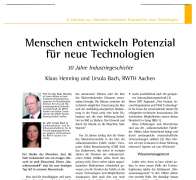
Which sustainable industrial developments remain to having shaped and changed our work in industry and production? If we look back, experience has shown that it is neither possible to develop fully automated factories nor to conserve all human knowledge by means of huge databases. These formerly trendsetting ideas are now outdated. But what we have learned from the failure of these ideas is a useful concept of the so-called HOT approach: First Human, Second Organization and Third Technology. This way, human knowledge and potential in combination with adequate organization can lead to technical innovation. At present, the challenge is to transfer this concept to recent and future ideas, such as the fully automated car or the change to the use of renewable energy sources. Thus, it should be taken into account that technical innovation must always include human and organizational aspects to be truly sustainable.
Industrie Management | Volume 30 | 2014 | Edition 1 | Pages 19-21
Blended Enterprise – a Realistic and Attractive Concept for Knowledge Management

Blended Enterprise - a Realistic and Attractive Concept for Knowledge Management

Michael Reiss, Dirk Steffens
The concept enterprise 2.0 stands for the enabling of new forms of know-ledge management by utilizing internet technology. While web 2.0 focuses on tools for communication, relationship management and learning, i.e. weblogs, wikis, and social networking platforms, enterprise 2.0 also covers the strategy, structure, and culture of knowledge management, and thus encompasses the entire enterprise. The authors argue that the vision of a blended enterprise is superior to existing non-hybrid enterprise 2.0-visions in terms of both feasibility and performance.
Industrie Management | Volume 26 | 2010 | Edition 1 | Pages 21-24
IT-Support for The Early Phases of Product Innovation

IT-Support for The Early Phases of Product Innovation

Felix Nyffenegger, Carmen Kobe
A lot of attention has been spent to the front-end of product innovation during the past decades. Different approaches to support the front-end were carried out from industry as well as in research. In parallel, the technological options in managing information and knowledge have been tremendously increased. This paper examines the question if - and how - the front-end of product-innovation can yet be supported by information technology: an overview on information objects in the early phases is given, standard software is evaluated and prototype - overcoming the shortcomings of existing software - presented.
Industrie Management | Volume 25 | 2009 | Edition 1 | Pages 45-48
Innovation is the Prerequisite of Growth

Innovation is the Prerequisite of Growth

Joachim Warschat, Dieter Spath, Peter Ohlhausen
This article tries to answer the question what implications innovation management will have on the future performance of companies. For this purpose a new approach has been developed that considers the time factor to be the determining element for the success of an innovation which also includes an invention. The developed model analyses the entire innovation process on several levels as well as the innovation performance and innovation capability of a company. This model permits to highlight critical elements within the company and the specific project, on the basis of existing data. This allows to give recommendations for optimisation and to evaluate modifications.
Industrie Management | Volume 22 | 2006 | Edition 5 | Pages 51-54