electric mobility

Increasing the Product Attractiveness of Electric Vehicles

Increasing the Product Attractiveness of Electric Vehicles

New product-service combinations
Ingo Westphal, Jasmin Nehls, Stefan Wiesner, Klaus-Dieter Thoben ORCID Icon
Product attractiveness can be substantially increased when offering service extensions alongside. These services may create additional demand for the product by addressing new customer groups. The main challenge however is the development of services which increase customer value of the product to such an extent that leads to a purchase decision. The paper presents a method of idea generation for new product-service combinations following a systematic search approach for possible options. The basic concept of the suggested method as well as its search methodology for identification of promising services will be discussed using the example of the electric car, which so far lacks mass market success due to inadequate business models.
Industrie Management | Volume 29 | 2013 | Edition 5 | Pages 19-24
After Sales Service for Electric Vehicles

After Sales Service for Electric Vehicles

New Conditions and Requirements Due to the Change of Technology
Sven Schulze, Christian Engel
Based on the prevailing opinion in industry, politics and science, in the automotive sector electric mobility is becoming increasingly important and will succeed in the long term. With the resulting displacement of internal combustion engines, new conditions arise for the stakeholders in the automotive industry. The value share of the electronics in the vehicle will continue to rise new suppliers and competitors will enter the market. But not only the production of the vehicles is exposed to new circumstances, in particular the automotive aftermarket is affected. The demand for services and spare parts will be displaced considerably so that all stakeholders must reposition themselves strategically in this market. The purposes of this paper are the new market conditions and the consequences for the stakeholders.
Industrie Management | Volume 28 | 2012 | Edition 5 | Pages 15-19
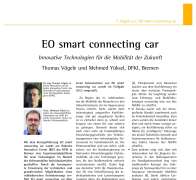
Innovative Technologies for Future Mobility

Innovative Technologies for Future Mobility

Thomas Vögele, Mehmed Yüksel
With EO smart connecting car, the DFKI Robotics Innovation Center in Bremen developed an experimental platform for new technologies in the area of electro mobility. Based on a consequent implementation of the electric drive train, the EO features functionalities that are important for a transition from traditional solutions for personal mobility to new mobility concepts of the future. An example for such functionalities is the ability of the EO to optimize itself for specific applications through morphologic modification and a modular architecture. A first demonstrator of the EO was presented in spring 2012.
Industrie Management | Volume 28 | 2012 | Edition 5 | Pages 37-40
Electric Mobility from an Extended Products Perspective

Electric Mobility from an Extended Products Perspective

Ergebnisse aus dem Projekt „Personal Mobility Center“ (PMC)
Jens Eschenbächer, Stefan Wiesner, Klaus-Dieter Thoben ORCID Icon
Electric mobility is currently subject to intensive discussions. New business models, products and services, as well as innovation concepts are developed by R&D and tested in real-life. In this context, the project “Personal Mobility Center” has been carried out in the Bremen/Oldenburg model region for electric mobility. On the basis of the Product Life-Cycle, first approaches for product-related services in the different phases of electric mobility have been worked out. Analysis of these “Extended Products” has shown that battery electric vehicles have to overcome several challenges before new mobility offers based on them can compete on the market.
Industrie Management | Volume 28 | 2012 | Edition 5 | Pages 25-28
Life Cycle Costing of Electric Vehicles from a User Perspective

Life Cycle Costing of Electric Vehicles from a User Perspective

Ein Vergleich des rein elektrisch und konventionell angetriebenen Smart Fortwo
Jens Kunath, Udo Buscher, Gerhard Golze
This article addresses the question whether a purely monetary-oriented user will decide to buy an entirely electrically powered vehicle today. For a vehicle that is available with petrol, diesel and electric drive, a life cycle cost analysis is performed. For this purpose, all cash inflows and outflows over the entire life cycle are covered, placed in a framework and finally the present value is determined to evaluate the alternatives. Making reasonable estimates special input parameters are varied in order to determine the resulting cost implications.
Industrie Management | Volume 28 | 2012 | Edition 5 | Pages 9-14