dynamics

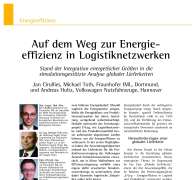
On the Way to Energy Efficiency in Logistics Networks

On the Way to Energy Efficiency in Logistics Networks

State of the Integration of Energy-Related Objectives into the Simulation-Based Analysis
Jan Cirullies, Michael Toth, Andreas Holtz
Globalization and the growing number of supply chain participants lead to increasing cargo transport service and, thus, to higher energy demand. Although energy prices increase at the same time, the energy balance of production networks remains unconsidered during in the network design phase. Hence, the research project E²Log analyzes how logistics networks and production environment can be coordinated in order to improve energy efficiency. In the first project phase, based on the supply chain for the production of the Volkswagen Amarok, the use case partners have derived simulation scenarios and enhanced a simulation tool to evaluate measures for the efficiency increase without ignoring classic logistic objectives soon.
Industrie Management | Volume 28 | 2012 | Edition 5 | Pages 20-24
Approximation and Robustness of Dynamic Production networks

Approximation and Robustness of Dynamic Production networks

Bernd Scholz-Reiter ORCID Icon, Michael Kosmykov, Thomas Makuschewitz, Fabian Wirth, Michael Schönlein, Sergey Dashkovskiy
Global production networks connect partners with outstanding expertise, and make use of regional cost advantages for purchasing and production operations. This development leads to an increasing structural complexity of the networks, which is accompanied by a closer collaboration of dynamic logistics processes. Hence, the resulting dynamics of a large-scale production network is characterized by the dynamics of the individual logistics processes, the dynamics of the network structure and dynamics of the external processes that affect the production network. However, in practice a lack of adequate procedures for the analysis and design of these networks can be observed. The presented article addresses this need by introducing tools and methods for the approximation of large-scale production networks, analysis of their dynamics and the robust design of the network resources.
Industrie Management | Volume 28 | 2012 | Edition 4 | Pages 51-56
Sustainable Supply Chain Management

Sustainable Supply Chain Management

Assessment of the Sustainable Application of Logistic Concepts in Corporate Networks
Jan Helmig, Jerome Quick, Henrik Wienholdt, Kerem Oflazgil
Since the turn of the millennium companies are confronted with a tightly interwoven network consisting of changed framework conditions. Thus, for many companies it is necessary to form a network, together with a simultaneous securing of liquidity. Additionally, it is important to consider ecological values. The selection of adequate concepts in the supply chain management in combination with the right extent in logistic services poses a major challenge. However the dynamic assessment and selection of logistic concepts is quite possible. This article presents such an approach.
Industrie Management | Volume 26 | 2010 | Edition 5 | Pages 58-60
Dynamics in Production Processes

Dynamics in Production Processes

Identifikation logistikrelevanter struktureller Veränderungen
Marco Kennemann, Steffen C. Eickemeyer, Eugen Schnurr, Peter Nyhuis ORCID Icon
environment poses huge challenges to production enterprises, especially with regards to logistics. The Logistic Operating Curve Theory, developed at the Institute of Production Systems and Logistics (IFA), is a recognized approach to describing logistic interactions, nevertheless, it reaches its limits when it comes to the dynamic aspects. In order to facilitate a timely and optimal Logistic Positioning a method is developed for quickly and reliably identifying dynamic processing states.
Industrie Management | Volume 26 | 2010 | Edition 5 | Pages 19-22
Influencing the Dynamics of Job-Shop-Productions by Design

Influencing the Dynamics of Job-Shop-Productions by Design

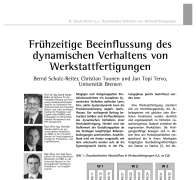
Bernd Scholz-Reiter ORCID Icon, Christian Toonen, Jan Topi Tervo
Job-shop-productions are facing high requirements due to the high diversity of manufactured products, changing lot-sizes and strongly cross-linked material flows. This situation is intensified by dynamic effects which are caused by non-linear dependences between the system’s parameters. The complex dynamics can affect the logistic performance of the system by varying stock-levels, rising cycle times or decreasing capacity utilisation. This paper describes an approach to analyse the effects of the factory planning process on the system’s dynamics, whereat the focus will be on the planning subtasks of dimensioning and structuring. This is expected to improve methods of design for job-shop-productions.
Industrie Management | Volume 25 | 2009 | Edition 3 | Pages 41-44
Analysis of Dynamics of Large-Scale Logistics Networks

Analysis of Dynamics of Large-Scale Logistics Networks

Bernd Scholz-Reiter ORCID Icon, Fabian Wirth, Sergey Dashkovskiy, Thomas Jagalski, Thomas Makuschewitz
Planning and control of logistics processes is more and more determined by an increasing complexity of structure of logistics networks and dynamics. However, in many aspects methods and tools for a comprehensive analysis of large-scale logistics networks are missing. This set of problems is the object of investigation in the new research project ‘Stability, Robustness and Approximation of Dynamic Large-Scale Networks - Theory and Applications in Logistics Networks’ founded by Volkswagen Foundation. The project will be run in a dual way: Mathematicians from the university of Bremen und the university of Würzburg cooperate with researchers from the field of engineering of the university of Bremen.
Industrie Management | Volume 24 | 2008 | Edition 3 | Pages 37-40
Management of Production and Logistics Under External Dynamics

Management of Production and Logistics Under External Dynamics

Carl Marcus Wallenburg, Jürgen Weber
Producing companies are increasingly facing external dynamics. To remain successful in the long run their management will have to keep up to this challenge. Thus it is important to choose and implement the right concepts and instruments to deal with dynamics. This article offers an overview on different approaches and a closer insight into the concept of Supply Chain Event Management.
Industrie Management | Volume 21 | 2005 | Edition 5 | Pages 45-48
Measuring and Assessing Logistical Agility

Measuring and Assessing Logistical Agility

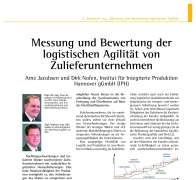
Arne Jacobsen, Dirk Nofen
Suppliers in turbulent markets find themselves confronted with additional logistical challenges. Customer orders and market demand may be satisfied through the development of a high reaction potential within the company. In order to adjust the production accord-ingly and to demonstrate the logistical abilities to the customers, logistical agility has to be measured and assessed first. A possible approach is the mathematical description of the synchronisation of production and distribution based on throughput diagrams.
Industrie Management | Volume 20 | 2004 | Edition 3 | Pages 45-48