control

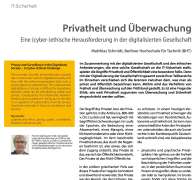
Privacy and Surveillance in the Digitalized Society

Privacy and Surveillance in the Digitalized Society

A (cyber-)ethical challenge
Matthias Schmidt
The concepts of public and private play a special role in connection with the digitalized society and thus with the ethical requirements that such a society places on cybersecurity. This is because the digitalization of society is shifting the boundaries between what can be described as public and private. Consequently, the relationship between freedom and surveillance is being put to the test. It is a question of (cyber-)ethics how far privacy should be restricted in favor of surveillance and security. (Only in German)
Industrie 4.0 Management | Volume 39 | 2023 | Edition 3 | Pages 10-13
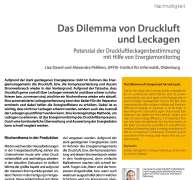
The Dilemma of Compressed Air and Leaks

The Dilemma of Compressed Air and Leaks

Lisa Dawel, Alexandra Pehlken
Due to the sharp rise in energy prices, compressed air, or compressor performance and its power consumption, are once again in the foreground as part of energy management. Due to the fact, that compressed air often escapes via leaks and these are difficult to localize or measure, a niche topic is becoming very noteworthy again. Automated leak detection can determine the need for repairs and help increase energy efficiency. It is important that not only leaks are detected, but that the extent of the leaks can also be quantified. A cost-effective method of detecting leaks is energy monitoring of the air compressor. Continuous monitoring and evaluation of the energy data means that you can react quickly.
Industrie 4.0 Management | Volume 39 | 2023 | Edition 2 | Pages 33-35 | DOI 10.30844/IM_23-2_33-35
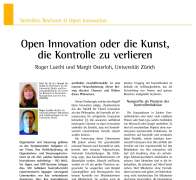
The Art of Losing Control

The Art of Losing Control

Roger Luethi, Margit Osterloh
Planning and control are fundamental goals that firms pursue at considerable expense. Illustrative examples include ISO 9001, Six Sigma and ERP systems. The exploration of radical control reduction has been left to communities of loosely connected amateurs. The success of Free and Open Source Software (FOSS) has shown that production models with low levels of control can be competitive. Commercial applications of these models promise competitive advantages to those who overcome the challenges of surrendering control and finding matching business models. This article outlines opportunities and risks associated with this phenomenon.
Industrie Management | Volume 26 | 2010 | Edition 3 | Pages 56-58
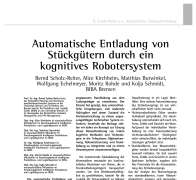
Concept for a Cognitive Robot System for Unlaoding Mass Goods Automatically

Concept for a Cognitive Robot System for Unlaoding Mass Goods Automatically

Bernd Scholz-Reiter ORCID Icon, Alice Kirchheim, Matthias Burwinkel, Wolfgang Echelmeyer, Moritz Rohde, Kolja Schmidt
Due to the increasing globalization of commodity flow a growth of mass good transportation is perceptible. Therefore automatic unloading of goods and their automatic transfer to logistic systems is one of the technical challenges. Opportunities arising from automatic goods unloading are explored in [1]. A system for unloading cubic goods automatically was developed and its introduction to market started last year. Changing environments and various operational areas are the motivation for research on a cognitive system for unloading goods. Hence, a concept for a cognitive system for unloading containers is introduced in this article. The components for such a system are image processing, robot control handling system and kinematics. For each of these components cognitive methods and technologies are proposed to be integrated in an overall system.
Industrie Management | Volume 24 | 2008 | Edition 4 | Pages 13-16
Selected Questions Concerning Economic Ramp-up Control

Selected Questions Concerning Economic Ramp-up Control

Georg Urban, Mischa Seiter
For the economic control of production ramp-up processes established instruments such as milestones exist. Also, there are several approaches to the planning and control of the factors time, costs, and quality. Those approaches, however, are not sufficient for the optimisation of production ramp-up. Therefore in this article the authors present three questions that have not been solved yet. These are the aggregation of the goals of the ramp-up by an integral controlling, the definition of the contribution to the shareholder value, and the coordination of the companies involved in corporate networks.
Industrie Management | Volume 20 | 2004 | Edition 4 | Pages 57-59
Proactive Controlling of Production Ramp-ups along the Value Chain

Proactive Controlling of Production Ramp-ups along the Value Chain

Jürgen Fleischer, Marc Wawerla, Peter Nyhuis ORCID Icon, Helge Winkler, Volker Liestmann
Due to shortening product life cycles and to the continuous enlargement of product ranges the ramp-up of production systems has become a significant criterion for innovation dynamics of producing companies. Besides the in-creasing technical complexity, a growing number of different parties are involved with different targets and interests. The result is a rising number of possible disturbances for the ramp-up process. In order to better control and shorten ramp-up projects, methods and tools have to be developed to manage the project along the complete value chain. The article gives an outlook on the ramp-up of the future by describing an approach that is the basis for a research project supported by the German ministry of research and education.
Industrie Management | Volume 20 | 2004 | Edition 4 | Pages 29-32