competitiveness

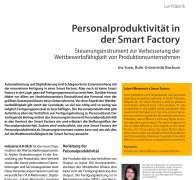
Labor Efficiency in a Smart Factory

Labor Efficiency in a Smart Factory

Steuerungsinstrument zur Verbesserung der Wettbewerbsfähigkeit von Produktionsunternehmen
Ina Yuen
Automatization and Digitalization are keywords regarding innovative assembly of Smart Factories. Despite all, no Smart Factory is able to produce completely without blue color workers. To stay competitive in the global world companies they need to find the balance to hire only as less employees as possible to guarantee all assembly processes. Therefore, Labor Efficiency is the key figure to control attendance and output. This article explains the role of labor efficiency with regards to the Smart Factory. For this purpose, the input factors attendance and output are explained and illustrated by practical examples. Moreover, it explains how labor efficiency can influence competitiveness positively.
Industrie 4.0 Management | Volume 38 | 2022 | Edition 2 | Pages 63-66
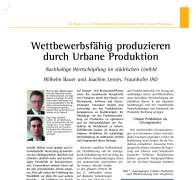
Urban Production as an Approach for Competitive Manufacturing

Urban Production as an Approach for Competitive Manufacturing

Nachhaltige Wertschöpfung im städtischen Umfeld
Wilhelm Bauer, Joachim Lentes
Volatile markets and global and inter-industrial networks are creating a radically more dynamic market environment calling for considerably greater on-demand flexibility and reductions in resource deployment. This results in a need for action in two further areas, namely increasing transformability and responding to demographic change. Today’s businesses have to respond to evolving these trends. Manufacturing will also have to adapt to the increasing dynamism of sales markets and the radical challenges thrown up by the innovation process, particularly in regard to energy and resource efficiency and the increasing hybridization of products using mechatronics, software and services. Innovative approaches are needed to accelerate the product creation process, optimize the transitions from product development to production, and ensure that the cost of manufacturing is competitive. This study examines constructive approaches in the area of urban production for sustainable added value in ...
Industrie Management | Volume 30 | 2014 | Edition 4 | Pages 7-10
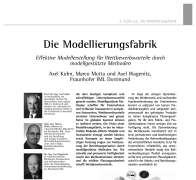
The Modeling Plant

The Modeling Plant

Effective modeling for improving competitiveness by model based planning methods
Axel Kuhn, Marco Motta, Axel Wagenitz
Today continuous planning is a prerequisite for competitiveness. Methods are required, that allow the handling of complexity in rapidly changing and complex networks. Model based methods provide insight in these networks and therefore help realizing advantages in competition. The vision of a modeling plant for building the required models effectively and in an industrial scale and concepts for long term usage of models will make model-based methods attractive for the industry. The validation of planning results using a model will advance the quality of planning and thereby create advantages in competition.
Industrie Management | Volume 24 | 2008 | Edition 2 | Pages 67-70
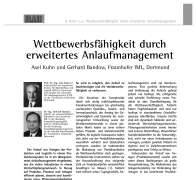
Competitiveness Through Augmented Start-up Management

Competitiveness Through Augmented Start-up Management

Axel Kuhn, Gerhard Bandow
The start-up of production and logistics equipment in a production system is embedded in a superior start-up management. This has to manage the different types of ramp-ups in a value-added network efficiently regarding to products, processes and equipment. Planning uncertainties and multifaceted faults increase the equipment manufacturer’s cost and effort substantially, often lead to delays, partially to delayed start-ups, and tie the system manufacturer longer than planned on the ground. Due to these reasons, a holistic and integrated start-up management is required. Thus, the start-up process accelerates and the competitiveness of all involved companies improves significantly.
Industrie Management | Volume 24 | 2008 | Edition 2 | Pages 55-58