competence management

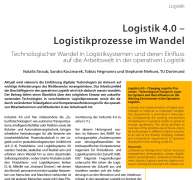
Logistics 4.0 – Changing Logistics Processes – Technological Changes in Logistics Systems and their Influence on the Working Environment in the Operative Logistics

Logistics 4.0 - Changing Logistics Processes - Technological Changes in Logistics Systems and their Influence on the Working Environment in the Operative Logistics

Natalia Straub, Sandra Kaczmarek, Tobias Hegmanns, Stephanie Niehues
Currently the implementation of digital technologies in response to important competition requirements is promoted in many places. Consequently, the working environment of employees in operative logistics is going to change significantly. This article provides an overview of the possible uses of future-oriented technologies in different logistics processes as well as the thereby changing subtasks and competence requirements of operative employees in the working world 4.0.
Industrie 4.0 Management | Volume 33 | 2017 | Edition 2 | Pages 47-51
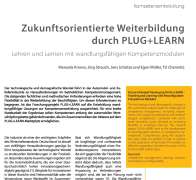
Future-Oriented Trainings by PLUG+LEARN

Future-Oriented Trainings by PLUG+LEARN

Teaching and Learning with Reconfigurable Competence Modules
Manuela Krones, Jörg Strauch, Jens Schütze, Egon Müller
The technological and demographic change in the automotive industry leads to challenges for competence management. Increasing requirements with regard to professional and methodological competencies, combined with shortened innovation cycles, demand an increasing flexibility in employee trainings. The research project PLUG+LEARN aims at the development of reconfigurable solutions in competence development. Competencies along the automotive value chain are pooled in order to achieve a wide application of the results. This enables an effective cooperation between the actors of the PLUG+LEARN market place.
Industrie 4.0 Management | Volume 32 | 2016 | Edition 3 | Pages 35-38
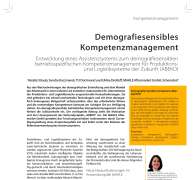
Demography-Sensitive Competence Management

Demography-Sensitive Competence Management

An assistance system for for production and logistics systems of the future (ABEKO)
Natalia Straub, Sandra Kaczmarek, Ulrike Drotleff
Demanding challenges arise through interactions of demographic development and change of modern working life in an industry 4.0., especially for enterprises of the production and logistics sector. While facing rapidly changing technologies and demographic homogenous personnel, they are requested to ensure that the required knowledge and the necessary competences are constantly recallable. A demographic-sensitive, operational competence management (ABEKO) plays a major role.
Industrie Management | Volume 31 | 2015 | Edition 3 | Pages 57-60
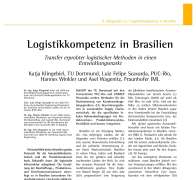
Logistics Competence in Brazil

Logistics Competence in Brazil

Transfer erprobter logistischer Methoden in einen Entwicklungsmarkt
Katja Klingebiel, Luiz Felipe Scavarda, Hannes Winkler, Axel Wagenitz
Brazil offers great potential, e.g. for the automotive industry. However procurement, production and distribution structures often lead to specific challenges. To cope with these challenges tested logistic planning approaches can be transferred. This article describes the cooperation between the Fraunhofer IML, Germany, and various Brazilian partners to initiate such a knowledge transfer and to adopt supply chain planning methods for the Brazilian automotive industry.
Industrie Management | Volume 27 | 2011 | Edition 2 | Pages 33-37
Changeability by Holistic Competence Management

Changeability by Holistic Competence Management

Günter Warnecke, Christian M. Thurnes
Changeable enterprises are sustainably focussing market and technology changes ranging from a short term up to long term view to maintain market success under changing market and environment conditions. The specific addressing of competence development can provide a significant contribution to changeable conditions. For these both, adaptive reactions to present changes as well as preventative planning addressing future changes are needed. To support the changeability of an enterprise holistic competence management approaches can be used. They allow to match supply and demand of competence and to design corresponding concepts for competence development.
Industrie Management | Volume 20 | 2004 | Edition 2 | Pages 9-11