changeability

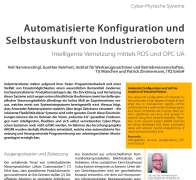
Automatic Configuration and Self-Description of Industrial Robots

Automatic Configuration and Self-Description of Industrial Robots

Intelligente Vernetzung mittels ROS und OPC UA
Veit Hammerstingl, Gunther Reinhart, Patrick Zimmermann
The setup and configuration of industrial robots presumes a high degree of expert knowledge due to manufacturer specific control commands and a wide variety of design types. As a result, companies are running robot systems repetitively over long time periods instead of using their inherent flexibility. Therefore, in the research project AKOMI methods are being developed that allow automated setup and solution neutral programming of robot assisted assembly lines.
Industrie 4.0 Management | Volume 32 | 2016 | Edition 6 | Pages 17-21
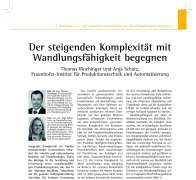
Encountering the Increasing Complexity by Changeability

Encountering the Increasing Complexity by Changeability

Thomas Wochinger, Anja Schatz
The increasing complexity in manufacturing companies’ business environment requires the fast response to changes with little effort. The article focuses the design and implementation of a changeable and versatile production system that transfers the well-proven tact-oriented principle to the whole order management process. The realization is illustrated by practical examples.
Industrie Management | Volume 29 | 2013 | Edition 6 | Pages 61-64
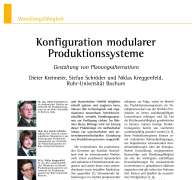
Configuration of Modular Production Systems

Configuration of Modular Production Systems

Designing of planning alternatives
Dieter Kreimeier, Stefan Schröder, Niklas Kreggenfeld
The steadily alternating requirements for industrial companies implicate the challenge to enhance production systems. In such a turbulent as well as dynamic environment, companies must be enabled to act and react quickly. Therefore they have to be equipped with appropriate technologically and organizationally realizable as well as economically rentable options. Within this paper, a methodical approach for a systematic and individual configuration of production systems is presented in order to solve the depicted problems.
Industrie Management | Volume 29 | 2013 | Edition 4 | Pages 18-22
Change-specific Taxonomy in the Communication Process

Change-specific Taxonomy in the Communication Process

Tobias Mersmann, Tim Klemke, Peter Nyhuis ORCID Icon
Nowadays, companies deal with a hugh amount of challenges which are the reason to change the production system more and more often. To be able to do this a production system needs a sufficient degree of changeability. Caused on a change, a communication process between the user and supplier will be initialized. In an optimal communication process there will be no losses due to communication lacks. This article deals with a change-specific taxonomy which adds some items to a communication process to decrease losses during communication.
Industrie Management | Volume 28 | 2012 | Edition 6 | Pages 41-44
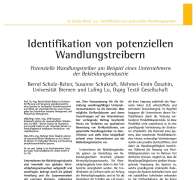
Procedure for the Identification of Change Drivers

Procedure for the Identification of Change Drivers

Potenzielle Wandlungstreiber am Beispiel eines Unternehmens der Bekleidungsindustrie
Bernd Scholz-Reiter ORCID Icon, Susanne Schukraft, Mehmet-Emin Özsahin, Luling Lo
Today, companies operating in the textile industry are integrated within value chain networks. Due to the global distribution and the cooperation with external partners, these companies underlie several influencing factors. In the case that the reaction to these influencing factors is not possible with the use of the existing flexibility, a basic adaption of the company structure is required. The potential to undergo these necessary changes is also named as changeability. To create changeable network structures it is firstly necessary to know about potential influencing factors and their impacts onto the company. The paper on hand therefore describes a procedure for the identification and evaluation of potential change drivers and introduces identified, potential change drivers using the example of a company that is active in the field of the apparel industry.
Industrie Management | Volume 28 | 2012 | Edition 6 | Pages 19-22
Designing Changeable Production Systems

Designing Changeable Production Systems

Holistic Identification and Analysis of Change Factors
Horst Meier, Dieter Kreimeier, Julia Velkova, Stefan Schröder
Internal and external influences of change plus the steady examination with continuous as well as discontinuous change constitute a great challenge for industrial companies to be mastered. The improvement of production systems towards variable and unpredictable requirements caused by a variety of company-specific impacts will be increasingly focused. In this article a concept will be introduced which helps to identify and analyze company-specific change factors systematically.
Industrie Management | Volume 28 | 2012 | Edition 2 | Pages 55-58
Professional Management of Complexity as a Basis for Agile Production Systems

Professional Management of Complexity as a Basis for Agile Production Systems

Leitbilder, Prinzipien und Werkzeuge
Michael Reiss
Although all approaches to proactive change management of production systems emphasize the relevance of complexity, an integrated building block “management of complexity” is not available. Based on a specification of the domains and dimensions of production complexity a framework for handling complexity is outlined. It covers guidelines, principles and tools for coping with the multiplicity, diversity, ambiguity and dynamics of production systems.
Industrie Management | Volume 27 | 2011 | Edition 3 | Pages 77-81
The Application of Simulation Modules to Hedge Changeable Logistics Systems

The Application of Simulation Modules to Hedge Changeable Logistics Systems

Sigrid Wenzel ORCID Icon, Björn Bockel, Dennis Abel
Changeability is the capability of an organization to establish changes with a lasting effect. The possibility to correctly plan and create changeability of an organization already in the phase of plan-ning is an essential factor to be taken into account when considering changeable logistics systems. For this reason there is a need for conceptual change of established planning methods. In the context of discrete-event simulation, as an established planning method, the modular design of simulation models may be a first step to include changeability into model-based analysis. Against this background, This article discusses possibilities to build modular simulation models and shows how this modular design can be used in practice.
Industrie Management | Volume 27 | 2011 | Edition 3 | Pages 33-36
Changeable Production Systems

Changeable Production Systems

Time data system for prospective planning and design
Olga Erohin, Matthias Krebs, Dominik Petzelt, Jochen Deuse ORCID Icon
Since the beginning of the 1990s the business environment of manufacturing industries has changed permanently. A majority of production systems have a lean, cost-effective and process-oriented structure. But this is still not enough for being successful in the long-term. The key factor for meeting challenges of a global market is the changeability of production systems. Instead of their recurring re-planning and rescheduling, they should be designed changeable right from the beginning of the planning phase. Time data is an important calculation and planning basis for this. In this paper we present a concept for dynamic time data management in planning and designing changeable production systems.
Industrie Management | Volume 27 | 2011 | Edition 3 | Pages 45-48
Evaluation Methodology for the Changeability of Production Systems

Evaluation Methodology for the Changeability of Production Systems

Tim Klemke, Dennis Goßmann, Carsten Wagner, Peter Nyhuis ORCID Icon
Nowadays, companies are facing a rapidly changing environment. New products have to be integrated into established manufacturing processes at ever shorter intervals. To assure competitiveness the design of changeable production systems gains more and more importance. Therefore, a control loop of changeability has been developed within the research project “change-supporting process architectures”. The control loop empowers companies to identify urgent changeability needs with an evaluation method and helps them to design and use change-supporting process architectures with economical solutions. The presented article focuses on the methodology for the evaluation of changeability.
Industrie Management | Volume 27 | 2011 | Edition 3 | Pages 53-56
1 2