Factory Planning

Integrative Site Development

Integrative Site Development

Fabrikplanung im Spannungsfeld von Market Pull und Technology Push
Serjosha Wulf, Peter Nyhuis ORCID Icon
The development of changeable factory concepts influences the site competitiveness of producing companies. The impact of the underlying factory structure, the factory layout, and the logistics on the operating efficiency of a factory concept is unquestioned. The influence of future production technologies or products on the factory concept, however, is often neglected. In a cooperative project a new method has been derived which allows a holistic coordination of all three elements factory, technology and product.
Industrie Management | Volume 25 | 2009 | Edition 4 | Pages 45-48
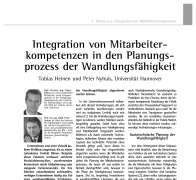
Integration of employee skills into the planning process of factory transformability

Integration of employee skills into the planning process of factory transformability

Tobias Heinen, Peter Nyhuis ORCID Icon
Enterprises face a plethora of outside influences. Examples include shortening product life cycles, rising cost pressure or increasing number of variants. In order to make arrangements for their factories to remain future-robust, many companies strive for a transformable factory. In order to fully use the change-potential installed, a methodology that allows integrating an employee-oriented view, is indispensable. This contribution presents an approach which renders possible the coordination of employee skills and factory transformability.
Industrie Management | Volume 25 | 2009 | Edition 3 | Pages 57-60
Influencing the Dynamics of Job-Shop-Productions by Design

Influencing the Dynamics of Job-Shop-Productions by Design

Bernd Scholz-Reiter ORCID Icon, Christian Toonen, Jan Topi Tervo
Job-shop-productions are facing high requirements due to the high diversity of manufactured products, changing lot-sizes and strongly cross-linked material flows. This situation is intensified by dynamic effects which are caused by non-linear dependences between the system’s parameters. The complex dynamics can affect the logistic performance of the system by varying stock-levels, rising cycle times or decreasing capacity utilisation. This paper describes an approach to analyse the effects of the factory planning process on the system’s dynamics, whereat the focus will be on the planning subtasks of dimensioning and structuring. This is expected to improve methods of design for job-shop-productions.
Industrie Management | Volume 25 | 2009 | Edition 3 | Pages 41-44
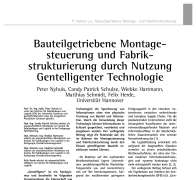
Gentelligent Technology

Gentelligent Technology

Peter Nyhuis ORCID Icon, Candy Patrick Schulze, Wiebke Hartmann, Matthias Schmidt, Felix Herde
„Gentelligence“ is a neologism and describes the property of parts to save, store and process data (intelligence) and further to pass information on to following generations of parts (genetic). Unlike existing technologies the gentelligent technology is able to store information without the physical separation of part and information. The present article highlights the potentials of gentelligent parts in assembly control and factory structuring.
Industrie Management | Volume 25 | 2009 | Edition 2 | Pages 13-16
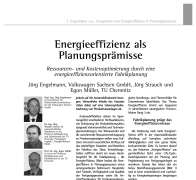
Energy Efficiency as a Premise for Planning

Energy Efficiency as a Premise for Planning

Ressourcen- und Kostenoptimierung durch eine energieeffizienzorientierte Fabrikplanung
Jörg Engelmann, Jörg Strauch, Egon Müller
The article presents an approach for the integration of the energy efficiency in factory planning processes. The main focus is not on the constructional hull but rather on the energy-efficient designing of production processes and production plants. The approach is of general validity but in the present example it is applied to the automotive industry. Main contents of the approach are aimed at the life cycle consideration of production plants.
Industrie Management | Volume 24 | 2008 | Edition 3 | Pages 61-63
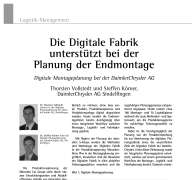
Digital Factory Supports Planning of Final Assembly

Digital Factory Supports Planning of Final Assembly

Thorsten Vollstedt, Steffen Körner
Production planning within the Mercedes Car Group is challenged by reduction of development times while increasing the product portfolio and quality. New approaches were necessary to implement the factorys needs into the product development as early as possible. 5 Years ago the Digital Factory was founded to secure that no production is started without a digital validation of product, production process and tools. Today the final assembly planning at DaimlerChrysler follows an integrated workflow of final assembly, Logistics and facility planning.
Industrie Management | Volume 23 | 2007 | Edition 5 | Pages 60-62
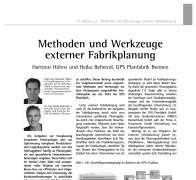
Methods and Tools of Industrial Planning Services

Methods and Tools of Industrial Planning Services

Hartmut Höhns, Heiko Behrend
Very often the redesign or optimisation of production systems, the shop floor or even entire plants is delegated to external specialists respectively consultancies or planning offices. Over many years and as well many projects they have gathered tremendous experiences in order to accomplish large-scale industrial projects. As a result of these experiences planning offices often develop their own special procedure models and tools to cope with the vast variety of different requirements of their customers and furthermore to create a distinctive profile or even some kind of a trade mark.
Industrie Management | Volume 23 | 2007 | Edition 3 | Pages 79-81
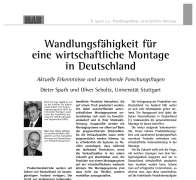
Mutability for a Profitable Assembly in Germany

Mutability for a Profitable Assembly in Germany

Aktuelle Erkenntnisse und anstehende Forschungsfragen
Dieter Spath, Oliver Scholtz
The trend of shifting abroad personnel-intensive mounting from Germany to foreign countries continues. The assembly systems widely differ in investment demand and in output. Since the sales figures can hardly be reliably forecasted any more, it is a necessity to construct extreme flexible systems which can be exchanged by more economical solutions, even when the production has already started and we know reliable sales figures and more reliable prognoses.
Industrie Management | Volume 23 | 2007 | Edition 2 | Pages 61-64
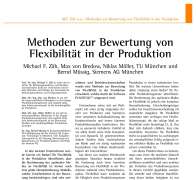
Methods for Flexibility Evaluation in Production

Methods for Flexibility Evaluation in Production

Michael F. Zäh, Max von Bredow, Niklas Möller, Bernd Müssig
Most enterprises have identified the need for flexibility, but the selection of the right degree of flexibility is a complex task. Sophisticated methods, which consider uncertainties in the valuation model, are time consuming and require a supporting software tool. The existing ones are applicable for very specific planning tasks only. In this paper, a methodology to support the valuation of manufacturing flexibility and PLANTCALC™, a supporting software tool, are presented. Both have been developed in a joint research project of the Institute for Machine Tools and Industrial Management and the Siemens AG.
Industrie Management | Volume 22 | 2006 | Edition 4 | Pages 29-32
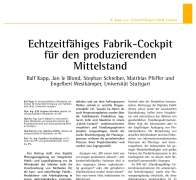
Real Time Factory Cockpit for Medium-Sized Businesses

Real Time Factory Cockpit for Medium-Sized Businesses

Ralf Kapp, Jan le Blond, Stephan Schreiber, Matthias Pfeffer, Engelbert Westkämper
This technical contribution presents a digital planning environment for an integrated facility layout and logistics planning. The aim is a noticeable reduction of time and effort for middle- and long-term facility planning and production planning. Therefore current data from the shop floor and order management are provided in an object-oriented consistent digital structure. This data is used to forecast the need for action and to deduct alternative solutions. Planning becomes more effective, long-term planning tasks become day-to-day activities so that the flexibility of the enterprise increases.
Industrie Management | Volume 22 | 2006 | Edition 2 | Pages 49-52
1 5 6 7