Production Planning

HANNOVER MESSE 2026 Banner
Cost Minimization by Demand Oriented Human Resource Allocation with OOPUS WEB

Cost Minimization by Demand Oriented Human Resource Allocation with OOPUS WEB

Wilhelm Dangelmaier, Daniel Brüggemann, Tobias Rust, Benjamin Klöpper
Flexible work times are a new opportunity to enhance the competitiveness of producing companies. To exploit this opportunity it must be considered during production planning and control. Available PPC and ERP systems do not sufficiently support the matching of required staff capacity and available (and paid) capacity. In this contribution we present the support of this matching process by the software OOPUS WEB.
Industrie Management | Volume 24 | 2008 | Edition 2 | Pages 35-38
Project Engineering

Project Engineering

Planning of complex development projects in the chemical industry
Christopher M. Schlick, Bernhard Kausch, Sven Tackenberg ORCID Icon, Werner Fuhrmann, Michael Strack
In development projects, a delay in connection with budget overruns is often the consequence of unrealistic scheduling. A simulation based approach for modeling development projects has been developed to support the project planner and will be presented in this paper. This novel approach allows the modeling and simulation of the project-specific structural organization and the process organization as well as the typical non-deterministic project behavior. Therefore, a realistic scheduling and resource allocation of complex development projects can be achieved. The application of the approach in projects of our industrial partners in the chemical industry has shown the suitability of the developed tools.
Industrie Management | Volume 24 | 2008 | Edition 2 | Pages 43-46
Ramp-Up-Forecast for Production Networks

Ramp-Up-Forecast for Production Networks

Horst Meier, Michael Homuth
Production Ramp-Ups are crucial for an industrial companies´ success. Business processes have to be controlled throughout the entire Production Network, what could be ensured by the use of modern workflow-based control methods. So far it is still questionable what should be the workflow’s goal. Looking at a ramp-up along the supply chain the process consists of a large number of local ramp-ups. For this a prognosis system will be introduced which allows an educated guess on the development of the number of pieces during the ramp-up. The prognosis is founded on a knowledge-based approach and does rely on multivariate data analysis. This will lead to a ramp-up forecast which could offer strategic aims into workflow-based network control tools.
Industrie Management | Volume 24 | 2008 | Edition 2 | Pages 63-66
Logistic Stock Analysis and Validation of Planning Methods

Logistic Stock Analysis and Validation of Planning Methods

Project results from the Siemens AG electronics plant in Amberg
Tim D. Busse, Matthias Schmidt, Felix S. Wriggers
The strategically appropriate dimensioning of inventory in the process chain is of utmost importance for companies. In this context inventory is utilized to counterbalance variations of the behaviour of customers as well as delivery date or quantity deviations caused by suppliers. It is a huge challenge to dimension the inventory as to realize a high level of security but also low stocks. This article demonstrates the methodical approach, the outcome of the Logistic Stock Analysis, and the validation of planning methods showcased for a project at the electronic factory of Siemens, Amberg.
Industrie Management | Volume 23 | 2007 | Edition 5 | Pages 75-78
One-Piece-Flow: A Versatile Concept for Series Assembly in Industry

One-Piece-Flow: A Versatile Concept for Series Assembly in Industry

Ein vielseitiges Konzept für die industrielle Serienmontage
Peter Scharf, Axel Kissing
This article points out the basic concept of „One-Piece-Flow” in the context of facility planning in manufacturing and shows examples of its successful application in assembly. The authors present configuration variants of this concept and they show the important design parameters with their effects on the system performance. While in the 80’s the principle of flow production was used only for large scale production and mass production, there is a new understanding today: the flow principle is also usable with advantages for medium quantity production, especially for assembly operations carried out by manual and by automatic work stations as well.
Industrie Management | Volume 23 | 2007 | Edition 3 | Pages 35-38
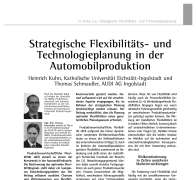
Strategic Flexibility and Technology Planning in the Automotive Production

Strategic Flexibility and Technology Planning in the Automotive Production

Heinrich Kuhn, Thomas Schmaußer
Manufacturing flexibility is currently one of the key trends within the automotive industry. In this context, the determination of the optimal degree of flexibility represents a complex decision problem. First of all this article clarifies chances and modes of operation of flexibility in the automotive production. Manufacturing flexibility can be used both to counter short- and medium-term market fluctuations and as a strategic approach to realize long-term costs advantages. Subsequently different aspects which have to be considered within the strategic planning are commented on in detail. The contribution clarifies that the planning of optimal flexibility requires an integrated planning approach.
Industrie Management | Volume 23 | 2007 | Edition 3 | Pages 39-42
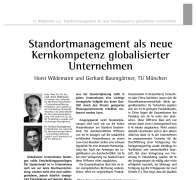
Production Site Management as a New Core Competence for Globalized Companies

Production Site Management as a New Core Competence for Globalized Companies

Horst Wildemann, Gerhard Baumgärtner
Global companies need a valid decision basis. The choice of a specific location is still not a standard decision within companies, but a mostly data-driven and finally strategic decision on top management level. The challenge there is to combine all single aspects according costs, qualitative and quantitative chances and risks to a conclusive picture. The decision process of production site management is an important strategic task, where as its quality can be significantly improved by using dedicated instruments.
Industrie Management | Volume 23 | 2007 | Edition 1 | Pages 23-26
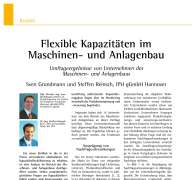
Impacts of Demand Volatility and Use of Flexible Capacities

Impacts of Demand Volatility and Use of Flexible Capacities

Survey results from companies in the mechanical and plant engineering sector
Sven Grundmann, Steffen Reinsch
The presented survey results aim to show an overview about the existing demand volatility and capacity flexibility in German manufacturing companies of the machining industry. Besides the consideration of logistical aspects regarding flexible capacities, cost aspects for accounting impacts of capacity options were taken into account. The result of the survey clarifies that the capacity options in companies seem to be sufficient. The cause of logistical problems due to demand volatility is located in insufficient methods for production monitoring.
Industrie Management | Volume 22 | 2006 | Edition 6 | Pages 42-44
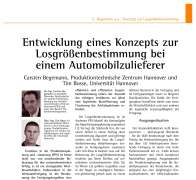
Development of a Concept for Lot Sizing for an Automotive Components Supplier

Development of a Concept for Lot Sizing for an Automotive Components Supplier

Carsten Begemann, Tim Busse
Today, excellence in production planning and control (PPC) is not only critical for the success of enterprises it is rather a strategic factor of competitiveness. Particularly in job shop manufacturing lot sizing is a vitally important function of PPC, due to its influence on the necessary positioning between manufacturing efficiency on the one hand and flexibility on the other hand. The article shows by example of a project of the IFA and the proIng GbR in cooperation with an automotive components supplier, that the development of a concept for effective an efficient lot sizing requires in addition to the selection of the suitable method a logistical analysis and classification of the products.
Industrie Management | Volume 22 | 2006 | Edition 4 | Pages 37-40
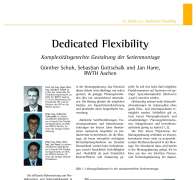
Dedicated Flexibility – Design to Complexity of Series Assembly

Dedicated Flexibility - Design to Complexity of Series Assembly

Komplexitätsgerechte Gestaltung der Serienmontage
Günther Schuh ORCID Icon, Sebastian Gottschalk, Jan Harre
Mastering high product variance and life cycle dynamics of demand can be an important competitive advantage in assembly. The main lever to this is a smart structuring of capacities and their assignment to assembly resources, such as lines, stations etc. The true benefit of this lever is hardly exploited due to poor support by established design methodologies. The article presents possible approaches to structure capacities in assembly and shows their exemplary use in practice.
Industrie Management | Volume 22 | 2006 | Edition 2 | Pages 21-25
1 6 7 8