Product Development

Integrated Project- and Change Management

Integrated Project- and Change Management

An Approach to Commercial and Technical Change Processing
Axel Hahn, Jan Strickmann, Hans-Dieter Hartmeier, Hardo Meier
Development projects are prone to continuous changes, whether because of additional insights or changes of requirmenents. To execute changes in a controlled and traceable manner, standardized methods and processes are used in product development, often as part of configuration management. The IT-support of configuration management with defined workflows and release mechanisms is provided by product data management systems (PDM). However, these often fail to acknowledge organizational and financial effects of a change on project management. To remedy this deficit, the article proposes an integrated project/macro-product model implemented by a semantic web and an ontology. This integrated model can be used to run metrics to analyse technical and commercial effects of a change thus improving the change management process as a whole.
Industrie Management | Volume 22 | 2006 | Edition 6 | Pages 34-38
Long-Term Acting Product Change Teams

Long-Term Acting Product Change Teams

Effektive Nutzung bestehenden Wissens zur gezielten Umsetzung technischer Produktänderungen in der Anlaufphase
Bernd Scholz-Reiter ORCID Icon, Farian Krohne
For an efficient implementation of technical product changes, industrial companies need to use a goal-oriented procedure as well as an effective application of already existing knowledge about previous product changes. Mostly, product changes are implemented by using standardised workflows, which are controlled and documented by common workflow-management-systems. The administration effort of these systems often causes delayed implementation of product changes. In this context companies try to optimise the product change process by implementing new application systems and by integrating existing isolated applications in these systems. The organisation of subgroups, who finally implement the product change, is often neglected. Thereby, the development of new approaches in this area may close the gaps in order to make knowledge available.
Industrie Management | Volume 22 | 2006 | Edition 6 | Pages 31-33
Process Changes – Obstacles during Run-Up of Production Systems

Process Changes - Obstacles during Run-Up of Production Systems

Bernd Scholz-Reiter ORCID Icon, Farian Krohne, Peter Nyhuis ORCID Icon, Michael Heins
In the conflict between greater customer requirements and a diversification in production industry, companies are forced to reduce ramp-up times significantly. The trend towards a continuous reduction of the time-to-market puts pressure on these companies and addresses the realisation of the expected market entry. More often this results in an inefficient production run-up, because the reduction in development time poses an important factor for later product changes. With regard to shorter product life cycles, it is expected that time for production and distribution will be extended. Cost-intensive product changes will reduce profit, which is why product change management becomes more and more important. Nevertheless, the effective management of process changes is not addressed sufficiently by today’s research. These in particular can be defined as most critical factors for an efficient production run-up.
Industrie Management | Volume 22 | 2006 | Edition 6 | Pages 15-18
PDM System of a Plant Constructor

PDM System of a Plant Constructor

Process-oriented integration of change management
Claus-Michael Seiler, Manfred Grauer, Axel E. Barten
In many enterprises applying product data management, the level of implementation does not correspond to the best available technology and the enterprises’ real requirements. Also for many different reasons, basic functions in process-oriented support of change management are often used only rudimentarily. Subject of this article is a concept to support particular enterprises of make-to-order production in implementing general change management based on up-to-date functions of product data management. The available core competences are efficiently applied in order to overcome the difficulties that are associated with the reutilization of existing methods of resolution.
Industrie Management | Volume 22 | 2006 | Edition 6 | Pages 47-50
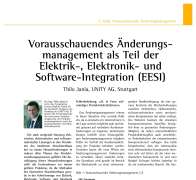
Foresighted Change Management

Foresighted Change Management

On the integration of electric, electronic and software components
Thilo Jania
The foresighted management of technical changes based on the EESI-Concept is fundamental for the management of specific electric-, electronic- and software requirements. The EESI-Concept comprises three integration steps, “Create transparency”, “Anticipation instead of documentation” and “Comprehensive realization”. The concept is based on a fundamental change in product and process documentation that is the complete documentation of all relevant information and interdependencies in form of an information net. The use of information nets for example even considers the interconnection between the electronic component, the software and the required installation and testing software. The foresighted change management then uses the complete documentation to simulate and analyze future product changes before their realization.
Industrie Management | Volume 22 | 2006 | Edition 6 | Pages 51-54
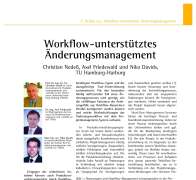
Workflow-Based Change Management in Complex Product Development Projects

Workflow-Based Change Management in Complex Product Development Projects

Christian Nedeß, Axel Friedewald, Niko Davids
Unlike common opinion the efficiency of product development projects can be increased by the application of workflow-management-systems. The basis for this provides a reference model for workflow-supported product development which classifies the required workflow types and software tools for the different tasks in the project. For the frequent case of a change management process it will be shown how different variants of this process can be configured through workflow modules and which interdependencies between workflow and project management system occur.
Industrie Management | Volume 22 | 2006 | Edition 6 | Pages 19-22
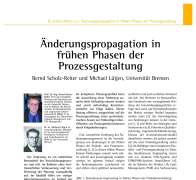
Product Change Propagation in Early Phases of Process Development

Product Change Propagation in Early Phases of Process Development

Bernd Scholz-Reiter ORCID Icon, Michael Lütjen ORCID Icon
The product change is a natural component of the development process and arises in the framework of a continuous improvement and refinement of planning inevitably. Ideally a constant information gain in the process of planning leads to a revision and an alteration of existing acceptance and concepts. A special case of the change is described by the Product Change Propagation. A local products change reproduces itself global and leads to a number of subsequent product changes, which can be measured heavily. In the complex planning surrounding the effect of a product change can be mostly not promptly recognised and will have complex correction loops as a consequence. This paper offers, aligned to the process organisation, a system-oriented approach for the early identification of planning inconsistencies by subsequent product changes.
Industrie Management | Volume 22 | 2006 | Edition 6 | Pages 7-10
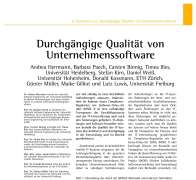
Integrated Quality of Corporate Software

Integrated Quality of Corporate Software

Andrea Herrmann, Barbara Paech, Carsten Binnig, Timea Illes, Stefan Kirn, Daniel Weiß, Donald Kossmann, Günter Müller, Maike Gilliot, Lutz Lowis
IT systems which operate in a dynamic environment must adapt to permanently changing business requirements. In particular new compliance rules like Sarbanes-Oxley-Act or BASEL II demand complete transparency of business processes and IT-support, also after changes. IT-departments and software providers need to clearly define and continuously assure the quality of the IT system during development and operation.
Industrie Management | Volume 22 | 2006 | Edition 6 | Pages 59-61
Process-Based Knowledge Management in Product Development

Process-Based Knowledge Management in Product Development

Phasenübergreifender Wissenstransfer unterstützt den Produktentwicklungsprozess
Sigrid Wenzel ORCID Icon, Christian Willmann
Preserving and re-using experience and knowledge from employees is a decisive task in industrial engineering. In this context the usage of tools for knowledge management is highly up-to-date, however a concrete implementation starts very unassertively in practise. The article discusses advisability and feasibility of a process-based knowledge management. A method of resolution in form of a knowledge infrastructure is worked out exemplary for the two phases “product planning” and “product design” linking the tools of knowledge management with knowledge-related tasks of the product development process.
Industrie Management | Volume 22 | 2006 | Edition 5 | Pages 43-46
Productclusterspecific Product Change Classification

Productclusterspecific Product Change Classification

The Enabler of an Efficient Product Change Management during Series Ramp-Up?
Bernd Scholz-Reiter ORCID Icon, Farian Krohne
The management of production ramp-up of complex series products is one of the critical success factors for companies. Shorter ramp-up phases become more important for companies because an early time-to-market means extra gains right after market launch. Nevertheless, reduction of production ramp-up is mostly realised by time savings in the phase of product development. This is one of the reasons for a lot of product changes, which occur during production ramp-up and whereby original equipment manufacturers as well as suppliers are forced to renew already used series tools. To reduce unnecessary expense of tool replacement a forward displacement and a faster implementation of technical product changes are required. In this context the product change classification offers significant but until today unused potentials.
Industrie Management | Volume 22 | 2006 | Edition 4 | Pages 15-19
1 10 11 12 16