Autor: Michael Lütjen

City Logistics

City Logistics

Michael Lütjen ORCID Icon, Jakub Piotrowski
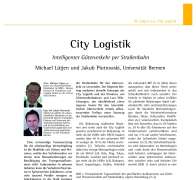
One of the main challenges in urban logistic is the collaborated handling of freight transportation and urban public transport. Especially during peak periods, e.g. when commuters travel between their place of residence and place of work, the urban infrastructure for car traffic and public transport risks to collapse. In addition, often the freight transportation in urban areas competes with the public transport because of the use of the same road infrastructure. Therefore, it would make sense also to use free capacities of public transportations like trams for freight transports. First, this paper analyzes current concepts of urban logistics and concepts for the use of freight trams. Second, a new approach for the use of autonomous trolleys combined with the use of public trams will be introduced by the authors.
Industrie Management | Volume 28 | 2012 | Edition 2 | Pages 47-50
Weather-Dependent Planning

Weather-Dependent Planning

Improving supply chain and offshore plant control
Bernd Scholz-Reiter ORCID Icon, Anne Schweizer, Michael Lütjen ORCID Icon, Wolf Lampe
The assembly and usage of offshore wind energy plants will increase during the next years. The German government updated the Renewable Energies Act in 2009 which pushes the offshore development ahead. One German offshore wind energy park has been assembled and put into operation so far. Transport, construction and assembly underlie strong influences like weather conditions on sea as well as material availability. The presented article shows these influences and a concept in which adaptive planning and control strategies are used to keep the overall process under control.
Industrie Management | Volume 26 | 2010 | Edition 6 | Pages 62-66
Logistic Quality Control in Micro Forming

Logistic Quality Control in Micro Forming

Einsatz von Fuzzy-Regelung zur Optimierung von Stichprobenintervallen
Bernd Scholz-Reiter ORCID Icon, Michael Lütjen ORCID Icon, Dennis Lappe, Hendrik Thamer, Nele Brenner
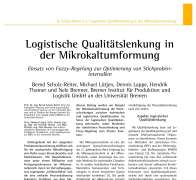
Due to the increased product miniaturization, a number of new applications and market opportunities open up for mechanical micro-manufacturing. In the manufacturing process with part dimensions less than one millimeter and tolerances in the micrometer range occur so-called “size effects”. These prevent a simple scaling of processes known methods from the macro level and lead to an increased occurrence of quality deviations. In conclusion, the process capability according to ISO 21747 is affected and therefore the application of statistical process control (SPC) is more difficult. In this paper, the interaction between technical and logistical quality objectives in terms of logistical quality control are analyzed at the example of micro cold forming. Thereby, methods of statistical process control and fuzzy control are used.
Industrie Management | Volume 26 | 2010 | Edition 4 | Pages 13-16
Surface Inspection of Micro Parts

Surface Inspection of Micro Parts

Bernd Scholz-Reiter ORCID Icon, Michael Lütjen ORCID Icon, Hendrik Thamer
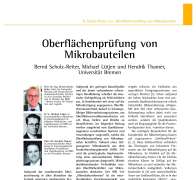
Due to the increasing miniaturization in all areas, mechanical manufacturing processes of micro-components become more important. The combination of high production cycles and low manu-facturing tolerances in the micrometer range requires a comprehensive quality management, which seeks efficient processes with low quality costs. Because of the small component sizes and the difficulties associated with the handling process, the classic visual inspection retires as testing procedure. In combination with a customized micro-manufacturing surface metrology, an efficient image processing system is needed to identify surface imperfections such as cracks, dents and scratches. This paper presents different standards and applications on the basis of quality management that affect the surface inspection of micro components. By reference to a micro-thermoformed component from the Collaborative Research Centre (CRC) 747, the prototypical implementation of an automated image processing system is ...
Industrie Management | Volume 26 | 2010 | Edition 3 | Pages 43-46
Digital Factory – Approaches for the integrated Product- and Process Design

Digital Factory - Approaches for the integrated Product- and Process Design

Bernd Scholz-Reiter ORCID Icon, Michael Lütjen ORCID Icon
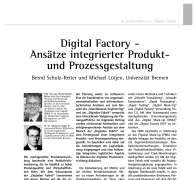
The market-oriented product development describes a focusing of needs, which leads ideally to high product quality and profitability. In the context of “Digital Factory” this paper focuses on the integrated product and process design, which is oriented to the physical part of the product. Due to the high product complexity, shorter product life cycles and increased competition situation is the product development faced with new challenges. Both the speed and the quality of planning should be improved further. Only the combination of organizational approaches and information technologies like for example “Simultaneous Engineering” and the “Digital Factory” promises a sufficient increase of planning efficiency. The following paper deals with existing methodologies and promising approaches in the field of “Digital Factory” against the background of an integrated product and process design. Referring to the requirements of logistics planning, an early integration of ...
Industrie Management | Volume 25 | 2009 | Edition 1 | Pages 19-22
Knowledge Management in Design of Micro Production Manufacturing Process Chains

Knowledge Management in Design of Micro Production Manufacturing Process Chains

Nutzung von Wiki in Forschungsnetzwerken
Bernd Scholz-Reiter ORCID Icon, Michael Lütjen ORCID Icon, Nele Brenner
The shortening of both time to market und product life cycle in combination with an increase of cost pressure, demand a fast and flexible product development process. The idea of simultaneous engineering is to gain time by treating product, process and resources in parallel and thus discovering discrepancies faster and adjusting the necessary factors. In order to establish an efficient knowledge management a wiki platform, here acting as a social software, is introduced. It serves as a centre of navigation within the process chain and supports the communication between the subprojects. Content can be edited by any member of the research project and may be discussed and changed by others. Its fast and free implementation qualifies the wiki tool and offers a secure and easy to handle platform.
Industrie Management | Volume 24 | 2008 | Edition 3 | Pages 53-56
Micro Factory – Concept for the Use of Mini Machines in Micro Production

Micro Factory - Concept for the Use of Mini Machines in Micro Production

Ein Konzept für den Einsatz von Miniatur-Maschinen in der Mikroproduktion
Bernd Scholz-Reiter ORCID Icon, Michael Lütjen ORCID Icon, Alice Kirchheim
The increasing demand of hybrid micro-technical systems resp. products in small to middle size lots, requires on the one hand new concepts from the micro production engineering and the production process planning and on the other hand methods for the development of micro production systems. Taking the postulation „small machines for small components“ into account, Micro Factories consist of highly specialized mini machines, each having a footprint of about 0,09 m² in comparison to 5 m² of conventional systems [1]. Micro Factories are arranged independently for each task to form a complex production system. Viewing the use of mini machines in micro production from the perspective of the production process, a concept for using adaptive, automatic quality control loops is proposed.
Industrie Management | Volume 23 | 2007 | Edition 3 | Pages 15-18
Product Change Propagation in Early Phases of Process Development

Product Change Propagation in Early Phases of Process Development

Bernd Scholz-Reiter ORCID Icon, Michael Lütjen ORCID Icon
The product change is a natural component of the development process and arises in the framework of a continuous improvement and refinement of planning inevitably. Ideally a constant information gain in the process of planning leads to a revision and an alteration of existing acceptance and concepts. A special case of the change is described by the Product Change Propagation. A local products change reproduces itself global and leads to a number of subsequent product changes, which can be measured heavily. In the complex planning surrounding the effect of a product change can be mostly not promptly recognised and will have complex correction loops as a consequence. This paper offers, aligned to the process organisation, a system-oriented approach for the early identification of planning inconsistencies by subsequent product changes.
Industrie Management | Volume 22 | 2006 | Edition 6 | Pages 7-10
The Importance of Operations Management in Micro Production

The Importance of Operations Management in Micro Production

Bernd Scholz-Reiter ORCID Icon, Michael Lütjen ORCID Icon, Hartmut Höhns
Recent investigations concerning the international state of the art of micro production technology [1, 2] showed, that it has to be distinguished between two main development directions regarding the manufacturing of function units on the one hand as well as complete products on the other hand. First of all there are the classical precision engineering oriented manufacturing methods [3, 4], e.g. according to the DIN 8580 [5]. Secondly manufacturing methods from the area of microsystems technology have been observed [3, 4]. The integration process of different product functions into one part or component geometry, which is running parallel to the miniaturisation, is a specific challenge regarding the field of micro manufacturing [1]. This affects especially the product and production process development, concerning the precision engineering oriented manufacturing methods. This paper addresses problems regarding the operations management of precision-engineering-oriented micro-production ...
Industrie Management | Volume 22 | 2006 | Edition 4 | Pages 9-14
1 2 3